
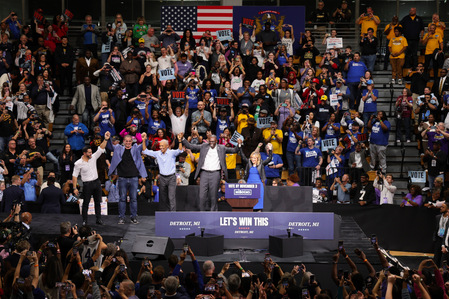
Washington, Nov 4 (IANS) Former US President Barack Obama on Wednesday hailed the Democratic Party’s sweeping midterm election victories as a rejection of divisive politics and urged the incoming congressional majorities to use their powers to check President Donald Trump’s administration, deliver practical solutions and prepare the country for a different political future.
Obama, who returned to the campaign trail in the closing days to support Democratic candidates in crucial battleground states, said voters had sent an unmistakable message by handing Democrats control of both the House of Representatives and the Senate.
“Tonight, the American people sent a clear message,” Obama wrote on X, saying voters wanted politics that brought people together rather than divided them.
The former two-term Democratic president attributed the victories to candidates who contested elections across the country, including in Republican strongholds previously considered difficult for Democrats.
He praised their different backgrounds and political perspectives, saying they shared a commitment to public service and the interests of their constituents.
Obama also thanked election officials and volunteers from both major parties for helping conduct the elections.
Looking ahead, he urged Democrats to “roll up our sleeves” and use their newly acquired political authority to make changes, limit what he regarded as damage from the administration and prepare for the future.
The statement followed a remarkable election night in which several candidates Obama had personally campaigned for defeated their Republican opponents.
In Ohio, Obama had travelled to Cleveland on October 24 to support Democratic gubernatorial candidate Amy Acton and former Senator Sherrod Brown.
Both won their elections on Tuesday.
Acton defeated Indian-American Republican Vivek Ramaswamy, who had received strong backing from Trump and Vice President J D Vance, while Brown unseated Republican Senator Jon Husted.
At the Cleveland rally, Obama had argued that the midterms offered voters an opportunity to restrain the administration through the democratic process.
“It’s the circuit breaker in the system,” he told supporters, arguing that congressional accountability and policies addressing household costs were central to the election.
Obama also criticised Ramaswamy’s campaign advertisement featuring Acton’s estranged mother, questioning the standards of conduct expected of candidates for public office.
Later that day, Obama travelled to Detroit to campaign for Democratic Senate nominee Abdul El-Sayed and gubernatorial candidate Jocelyn Benson.
Both emerged victorious.
In his Detroit speech, Obama acknowledged that El-Sayed, a progressive Democrat, had disagreed with some policies pursued during his presidency.
“Disagreeing on means is different from disagreeing on ends, on our goals,” Obama said, presenting the differences as part of a broader democratic coalition.
He also defended El-Sayed against political attacks involving his name and Muslim identity, drawing parallels with attempts to question Obama’s own background during his presidential campaigns.
El-Sayed’s victory made him the first Muslim elected to the US Senate.
Obama’s final major campaign appearances included an October 28 rally in Georgia alongside Democratic Senator Jon Ossoff and gubernatorial candidate Keisha Lance Bottoms.
Both won their elections, with Bottoms becoming the first Black woman elected governor in American history.
At the Georgia rally, Obama accused the Trump administration of mishandling economic policy, imposing tariffs that increased consumer costs and pursuing an unnecessary war with Iran.
He also warned Democrats against relying solely on criticism of Trump, arguing that they needed concrete proposals on healthcare, housing, utilities and living costs.
Obama’s post-election remarks reflected that campaign message: the party’s victories, he argued, created responsibilities beyond opposing the White House.
Obama served as the 44th US president from January 2009 to January 2017. His return to campaigning came as Democrats sought to regain control of Congress midway through Trump’s second presidential term.
The newly elected Congress will convene in January 2027. Democratic control of both chambers will give the party greater authority over legislation, spending and congressional oversight, including matters involving trade, immigration and foreign policy.
–IANS
lkj/ksk/as