
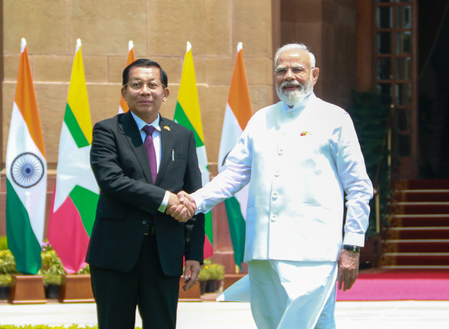
Naypyidaw/New Delhi, June 4 (IANS) The recent visit of Myanmar’s President U Min Aung Hlaing to India was driven by a sovereign strategic calculation.
Despite maintaining ties with China, given Beijing’s strong economic footprint in the Southeast Asian nation, the Myanmar government has sought to pursue a strategic counterweight through broader regional engagement. India offers Naypyidaw a partnership that does not evoke the same sovereignty concerns often associated with Beijing’s expanding influence, a report has stated.
“Myanmar’s President U Min Aung Hlaing arrived in India on May 30 for a five-day official visit—his first foreign trip since being sworn in as president in April 2026. While the visit was expected to be to Beijing, it could be interpreted as Naypyidaw attempting to reduce China’s influence and recognition of India’s policy of openness, while others prefer to isolate and pressure,” a report in India Narrative detailed.
The report highlighted that Myanmar has remained largely isolated since the military seized power in 2021, with Western governments and most ASEAN member states condemning the junta and backing the National Unity Government formed by ousted elected leaders.
“China has filled the resulting vacuum, becoming Naypyidaw’s principal economic and diplomatic partner. Beijing’s interest was based on securing the China-Myanmar Economic Corridor—a Belt and Road Initiative project that links Yunnan Province to the deep-water port of Kyaukpyu on the Bay of Bengal. This gives Beijing strategic access to the Indian Ocean, bypassing the Malacca Strait,” it stated.
India, meanwhile, went with its policy of continued engagement with Myanmar. Following the June 1 talks, Foreign Secretary Vikram Misri said, “Our engagement with Myanmar is not intended to be a commentary on the internal political arrangements in that country. We have always proceeded on the principle that sustained dialogue is what is important.”
“Disengagement only produces a vacuum that others go on to fill, to our detriment,” Misri added.
The bilateral talks between Prime Minister Narendra Modi and President Min Aung Hlaing led to an agreement to enhance cooperation across several sectors, including trade, investment, connectivity, and border management, with particular emphasis on critical minerals and rare earth elements.
According to the report, New Delhi has sustained engagement with both the central government and the opposition groups in Myanmar.
“Rather than viewing Myanmar’s political fragmentation as a dispute to take sides in, India treats it as a practical reality to be managed. This dual-track diplomacy is now paying strategic dividends,” it noted.
In contrast, the report argued that ASEAN’s approach illustrates the “cost of non-engagement.” By sidelining Myanmar’s government and avoiding substantive dialogue, the bloc has weakened its influence in the region.
“India has adopted a different approach, and the visit in June 2026 provides clear evidence of the benefits, including a strengthened position as Naypyidaw’s favored regional partner, a critical minerals agreement that challenges China’s near-monopoly on Myanmar’s resource output, and a credible claim to regional leadership through the Act East policy,” the report mentioned.
–IANS
scor/ksk/as