
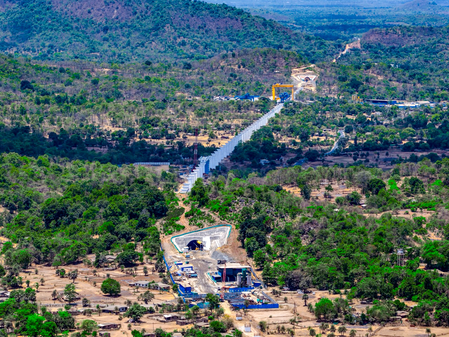
New Delhi, June 12 (IANS) The Mumbai–Ahmedabad High-Speed Rail (MAHSR) Project represents a transformative phase in India’s railway development — as the country’s first high-speed rail corridor which is introducing new standards in speed, connectivity, and infrastructure delivery, according to an official factsheet issued on Friday.
Significant advancements in civil works, bridge construction, and tunnelling indicate steady momentum towards project completion. The scale of construction achieved so far demonstrates steady progress across multiple project components.
At the same time, the adoption of advanced technologies and engineering practices is strengthening domestic capabilities in high-speed rail development. The first high-speed rail service on the corridor is expected to commence in August 2027.
The MAHSR project will reduce travel time between Mumbai and Ahmedabad to under two hours. The same journey currently takes 8-9 hours by road and around 4-5 hours by air, including airport procedures. Faster travel can improve business efficiency and save valuable time for passengers.
Currently, the highest design speed in the Indian railway network is around 180 kmph, achieved by semi-high-speed services such as Vande Bharat. Against this, the Mumbai–Ahmedabad High Speed Rail (MAHSR) Project has a design speed of 350 kmph and an operational speed of 320 kmph.
It is one of the most extensive rail infrastructure programmes undertaken in India, and will connect Mumbai and Ahmedabad in about 1 hour 58 minutes.
The MAHSR project serves not only as a transportation initiative but also as a catalyst for India’s long-term high-speed rail ambitions.
Besides providing high-speed passenger transport, this project will also establish for the first time, a domestic high-speed rail ecosystem. This ecosystem includes viaduct construction, ballastless track installation, tunnelling, bridge launching, and station-area planning.
It also includes signalling and power systems, along with specialised training for Indian engineers and technicians. The knowledge, skills, and capabilities developed through the project are expected to support future high-speed rail corridors across the country.
The 508-kilometre MAHSR corridor passes through Maharashtra, Gujarat, and Dadra & Nagar Haveli. The corridor comprises 12 stations at Mumbai (BKC), Thane, Virar, Boisar, Vapi, Bilimora, Surat, Bharuch, Vadodara, Anand, Ahmedabad, and Sabarmati. Each station is designed to reflect the character and spirit of its host city. Contemporary architecture, modern amenities, and multimodal connectivity are integral to their design.
Sabarmati station is being developed as a multimodal hub linking the bullet train, metro, BRTS, and railway networks. The surrounding area is also being planned following transit-oriented development principles.
The project is being developed using Japanese Shinkansen technology and operational standards. The corridor incorporates advanced systems for traction, electrification, track infrastructure, and operations.
The route is about 90 per cent elevated, with construction being carried out primarily through the Full Span Launching Method (FSLM). This technique is being used in India for the first time and is ten times faster than conventional segmental construction. Noise barriers are being installed on both sides of the viaduct to minimise operational noise. Together, these features highlight the corridor’s focus on efficient construction, operational performance, and integrated urban development.
Spanning nearly 4,000 kilometres, the proposed corridors are expected to attract investments of approximately Rs 16 lakh crore. These developments signal a shift towards high-speed rail as a key component of India’s transport infrastructure, the factsheet added.
–IANS
sps/na