
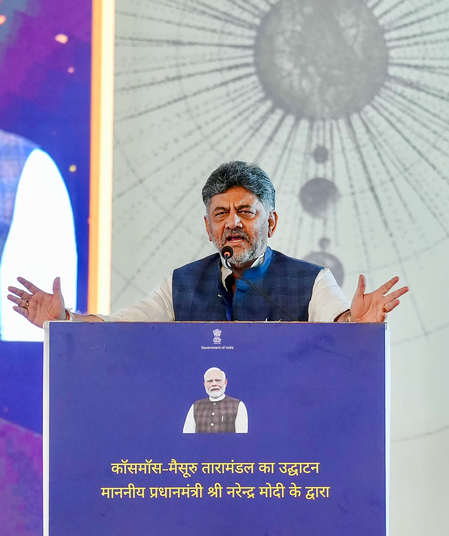
Mysuru, Nov 13 (IANS) Karnataka Chief Minister D.K. Shivakumar on Friday placed three major demands before Prime Minister Narendra Modi, seeking statutory clearances for the Mekedatu reservoir project, withdrawal of the Kasturirangan report recommendations on the Western Ghats and permission to utilise Corporate Social Responsibility (CSR) funds in accordance with state guidelines to upgrade 1,000 government schools into Karnataka Public Schools.
Speaking at the inauguration of COSMOS-Mysuru Planetarium and Bharat Van, Shivakumar said cooperation between the Union and state governments was essential to address Karnataka’s developmental needs and challenges.
He said the Supreme Court had already delivered a favourable ruling for Karnataka on the Mekedatu project and that the legal aspects had been settled. Urging the Centre to grant the final statutory clearances without further delay, he said the project was important for meeting drinking water requirements.
On the Kasturirangan report, he said the Karnataka Legislature had unanimously passed a resolution opposing its recommendations. The state government had also collected public opinion and held extensive consultations with people in the affected regions.
“The Centre should respect the sentiments of the people and the ground realities of their lives. The recommendations of the Kasturirangan report should be withdrawn without affecting the livelihoods of local communities,” he said.
Raising the issue of education and CSR funding, Shivakumar said parents were increasingly migrating to urban areas in search of better educational opportunities for their children, resulting in economic and demographic imbalances.
He said migration for education and employment had increased from 31 per cent in 2002 to 47 per cent in 2026 and could reach 70 per cent over the next two decades if the trend continued.
He urged the Union Ministry of Corporate Affairs to issue an advisory directing companies to implement CSR projects in Karnataka in accordance with the state government’s guidelines. This would facilitate the upgradation of 1,000 government schools into Karnataka Public Schools and strengthen the public education system, he said.
Describing COSMOS Planetarium as another significant scientific landmark for Mysuru, Shivakumar said the city, known for its heritage, knowledge and culture, would gain a new identity through the facility.
He thanked Union Finance Minister Nirmala Sitharaman for her support in bringing the project to Mysuru and said the centre would become a source of pride for Karnataka.
Highlighting Karnataka’s contribution to India’s space programme, he said the state’s role in the country’s achievements, from the first Indian satellite Aryabhata to Chandrayaan, Aditya-L1 and the Gaganyaan mission, could not be overlooked.
Bengaluru had emerged as a major centre of India’s space programme, with institutions such as the U.R. Rao Satellite Centre (URSC) and ISRO Telemetry, Tracking and Command Network (ISTRAC) supporting several important national space missions, he said.
The state government was establishing science centres in Shivamogga, Raichur, Yadgir and Chikkamagaluru at a combined cost of around Rs 59 crore. The construction of the Shivamogga centre was almost complete, while work on the Raichur centre was progressing. Steps were also being taken to establish centres in Yadgir and Chikkamagaluru, he said.
The Bengaluru Science City, announced in the 2024-25 Budget, was planned at Hosahalli in Doddaballapur taluk at an estimated cost of Rs 230 crore.
Planetariums were already functioning in Bengaluru, Mangaluru and Gadag, while the facility at Chittapur was ready for inauguration. Planetariums were also being constructed in Dharwad, Madikeri, Belagavi and Bagalkot, he said.
Shivakumar said he would direct the Department of Science and Technology to examine the possibility of establishing a science and planetarium facility on the lines of COSMOS in North Karnataka to provide students in the region access to advanced scientific infrastructure.
Under the mobile digital planetarium initiative, more than 19.21 lakh students and teachers had experienced the wonders of space within their schools. Telescopes had also been distributed to 833 Karnataka Residential Educational Institutions Society (KREIS) schools and colleges, enabling students to observe planets, stars and other celestial bodies.
Special training programmes had been organised for science teachers in collaboration with the Indian Institute of Astrophysics and the Jawaharlal Nehru Planetarium, he said.
The Karnataka Space Technology Policy 2025-30 aimed to promote startups, strengthen research, create skilled human resources and establish links between industries and academic institutions.
He added that Karnataka had become the first state in India to establish a state government-led Centre of Excellence in Space Technology to encourage innovation, startups and commercial opportunities.
The Indian Institute of Astrophysics had made significant contributions to astronomy and solar science, including developing a key payload for the Aditya-L1 mission, he said.
Recalling former President and scientist A.P.J. Abdul Kalam’s words, Shivakumar said dreams transformed into thoughts and thoughts into action.
Referring to Bharat Van, developed using the Miyawaki method of afforestation, he said the initiative would help make Mysuru a greener, healthier and more sustainable city.
“Trees connect human beings with nature, while a planetarium nurtures our imagination and thinking,” he said, adding that a developed India required both a greener environment and a younger generation equipped with scientific thinking.
Union Minister for Finance and Corporate Affairs Nirmala Sitharaman proposed the welcome speech and presented a special memento to Prime Minister Narendra Modi at the event. The memento displayed the three solar images, uniquely combining India’s scientific legacy and its awakening to freedom.
The images are reproductions of observations recorded at the Kodaikanal observatory on 15th of August 1947, the day India attained independence.
–IANS
mka/dan