
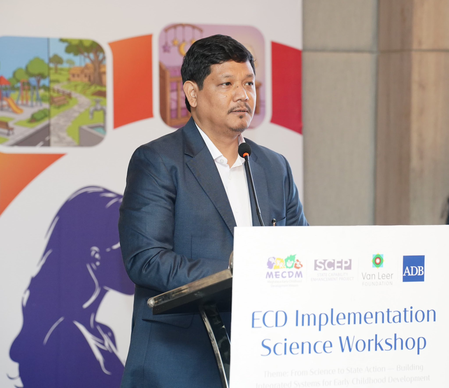
Shillong, June 1 (IANS) Meghalaya Chief Minister Conrad K. Sangma on Monday stressed the need for stronger implementation systems, integrated governance, and outcome-oriented policymaking to improve early childhood development, maternal health, and social welfare outcomes in the state and across the country.
Addressing the inaugural session of the three-day Early Childhood Development (ECD) Implementation Science Workshop in Shillong, Sangma said governments often already understand the science, data and policy solutions behind developmental challenges, but the real task lies in effective implementation and collective political will.
Speaking at the event held at Vivanta, Shillong, the Chief Minister recalled that when he first assumed office in 2018, he had emphasised that meaningful change does not necessarily require new schemes or policies, but rather improved implementation of existing programmes.
Quoting an author, Sangma said he had once responded to a question from the media by saying that he “would not do anything different, but would do things differently”.
He said both the Central and State government schemes are largely designed to address developmental challenges, but progress depends on how efficiently they are implemented on the ground.
Highlighting Meghalaya’s governance reforms, Sangma said stronger implementation mechanisms had significantly improved the utilisation of centrally sponsored schemes and externally aided projects.
Referring to MGNREGA, he said improved execution had resulted in nearly a threefold increase in utilisation and absorption capacity. He further noted that Meghalaya is currently implementing externally aided projects worth nearly Rs 12,000 crore, exceeding the portfolios of several other small states.
“The point I am trying to make is that we often know the problems. We understand the science, the data and the analysis behind them. But ultimately, there has to be a will to make a difference,” the Chief Minister said.
Sangma stressed the importance of identifying practical and locally relevant solutions rather than relying on one-size-fits-all approaches.
Referring to Meghalaya’s efforts to reduce maternal mortality, he said the government initially believed that increasing institutional deliveries alone would solve the problem, but later realised that economic and logistical barriers were major factors.
“We were encouraging institutional deliveries without recognising the economic realities these mothers faced,” he said.
The Chief Minister explained that instead of investing heavily in ambulances, the government created a locally adapted transport support mechanism involving community vehicle owners, while also establishing Safe Motherhood Homes for expectant mothers from remote areas.
“The lesson here is that we must identify where the actual problem lies and then design solutions that are practical, affordable and tailored to local realities,” he added.
Referring to the upcoming National Games and recently completed sports infrastructure projects, including a Rs 160-crore indoor stadium, he said the real success of such investments would be measured by improvements in the lives and achievements of young athletes.
The Chief Minister said Meghalaya has increasingly adopted an integrated governance approach linking health, education, nutrition, rural development and social welfare. He said this thinking eventually led to the creation of the MOTHER programme — Meghalaya’s Outcome and Transformation in Health, Education, Rural Development and Social Benefit — which brings multiple departments together around maternal and child welfare.
“We are no longer looking at departments or schemes in isolation. We are looking at a human life and asking how government can support that life at every stage,” he said.
Sangma further highlighted the link between economic empowerment and maternal and child health outcomes, noting that the expansion of Self-Help Groups in Meghalaya from around 4,500 to nearly 60,000 over the last eight years has contributed to broader social and developmental gains.
Emphasising cooperative federalism, the Chief Minister said states must continue learning from one another through platforms that encourage innovation, collaboration and knowledge exchange. “There are no small states or big states when it comes to innovation and good governance,” he said.
The three-day workshop has brought together policymakers, development practitioners, experts and government officials from across the country to deliberate on issues related to early childhood development, behavioural science, systems strengthening and adaptive leadership.
–IANS
tdr/skp