
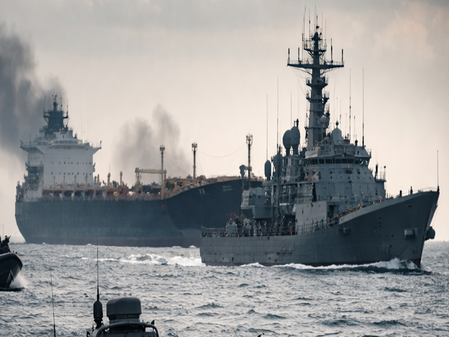
New Delhi/London, March 5 (IANS) The maritime threat landscape across the Gulf of Oman, Persian Gulf, and Strait of Hormuz has turned highly volatile in the past 24-48 hours, driven by escalating military confrontations involving Iran, the US, and Israel.
Multiple projectile, missile, and explosive incidents have targeted commercial shipping, prompting a near-total halt in transits through the critical chokepoint.
Since late February, when US and Israeli strikes on Iranian targets triggered retaliatory actions, the region has seen confirmed attacks on several merchant vessels.
Reports detail at least three to eight commercial ships damaged or struck, including tankers and a container ship hit by projectiles in the Strait of Hormuz and Gulf of Oman approaches.
Casualties have been reported, with at least one seafarer killed and others injured in incidents involving drone boats, missiles, and near-misses. Shipping traffic has plummeted dramatically.
The Strait of Hormuz, through which roughly 20 per cent of global seaborne oil and liquefied natural gas normally flows, saw only a handful of crossings in recent days — far below baseline levels — with some tracking platforms recording near-zero active transits in main lanes.
Hundreds of vessels, including oil tankers and LNG carriers, remain anchored in regional waters or clustered at safe havens, while major operators like Maersk and Hapag-Lloyd have suspended Hormuz passages entirely. Some lines are rerouting around the Cape of Good Hope, significantly extending voyage times and costs.
Compounding the kinetic threats, “persistent GPS and AIS jamming” continues to severely impair navigation safety.
Maritime intelligence firms like Windward have detected widespread electronic interference, with over 1,100 vessels affected in recent days—showing spoofed positions placing ships on land, at airports, or at nuclear sites.
This has created denial zones and injected false signals across the Gulf, heightening collision risks and complicating situational awareness. In response, war-risk insurance providers — including Gard, Skuld, NorthStandard, London P&I Club, and the American Club — have issued cancellation notices for coverage in Iranian waters, the Persian Gulf, and adjacent areas, effective from March 5 onward.
This has forced ship owners to seek prohibitively expensive alternatives or avoid the region, effectively paralyzing commercial operations. The Joint Maritime Information Center (JMIC) has elevated the regional threat level to “CRITICAL”, indicating attacks are almost certain.
US MARAD advisories urge vessels to avoid the area if possible, maintain 30-nautical-mile standoffs from naval assets, and implement enhanced measures. Merchant vessels are strongly advised to exercise “heightened vigilance”, enforce enhanced watchkeeping, cross-verify all navigation inputs (including radar and visual bearings), and strictly adhere to “Best Management Practices (BMP5 or MS)” security protocols while transiting or operating in the region.
Monitoring of UKMTO, JMIC, and NAVCENT advisories remains essential. The situation underscores the fragility of global energy supply chains, with potential for further escalation amid ongoing hostilities.
Authorities continue to monitor developments closely as the crisis risks broader economic repercussions.
–IANS
sktr/pgh