
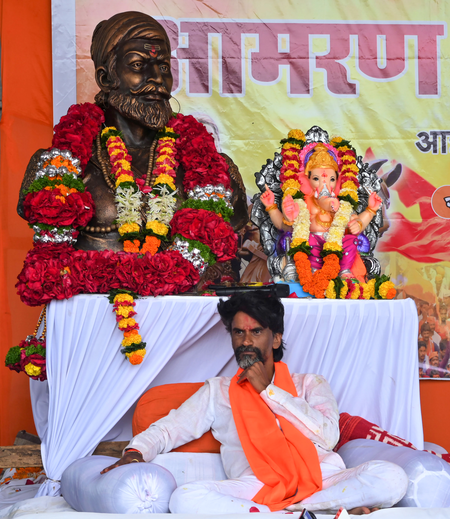
Mumbai, May 30 (IANS) Maratha quota activist Manoj Jarange Patil, setting aside the comforts of protest pandals, on Saturday launched his ninth indefinite hunger strike here under the blazing May sun.
Rejecting last-minute government delegation led by the Maharashtra Water Resources Minister Radhakrishna Vikhe-Patil, Jarange Patil has opted for an extreme form of protest by sitting in the open without food, water, or shelter, accusing the MahaYuti government of pushing the community through an “agnipariksha”.
This escalation marks a profound shift from his highly publicised march to Mumbai in January 2024.
While that mobilisation forced the state framework to hold negotiations, this renewed agitation highlights a critical reality which is despite Legislative promises, the core issue of the Maratha reservation remains an unresolved, volatile political driver in Maharashtra.
The transition of Jarange Patil’s movement from the gates of Mumbai back to its rural epicentre in Jalna reflects more than a change of scenery.
It represents a pivot from macro-political demands to granular, micro-level enforcement issues.
While the Mumbai March focused on securing a broad policy framework and establishing a legal path to classify Marathas as Kunbis for Other Backward Classes (OBC) status, the current fast at Antarwali Sarati targets bureaucratic inertia, “bogus” OBC listings, and administrative and procedural delays in implementing the Satara and Hyderabad Gazettes.
They are the crucial historical, administrative documents that record the socio-economic status of families in western Maharashtra and the Marathwada region, and are being used by activists as official proof that local Marathas were historically classified as agrarian Kunbis, thereby qualifying them for modern OBC reservation benefits.
The initial protest in Mumbai relied on a massive show of strength by marching thousands of supporters to the borders of the financial capital to force an immediate ordinance, whereas the current agitation uses a high-risk, localised solitary strike under extreme summer heat to create immediate moral and physical urgency.
Undeterred by scorching summer heat, the pro-Martha quota activists are thronging to the hunger strike venue for extending their support to Jarange Patil.
During the Mumbai protest, the movement maintained a stance open to negotiation while waiting for state-issued draft notifications and official Government Resolutions (GRs); in contrast, the current stance is highly confrontational, with Jarange Patil and his supporters actively accusing deceptive delays and putting the community through cruel trials.
When Jarange Patil marched on Mumbai, the battle was over a piece of paper — the extraction of a promise. Today’s protest is driven by the friction of implementation.
Jarange Patil, after talks failed with the government delegation, claims the MahaYuti government is deliberately dragging its feet on validating 58 lakh Kunbi documents sourced from historical records.
While the state government claims that more than 2.5 lakh certificates have been distributed in Marathwada and that complex validation requirements are slowing the rest, Jarange Patil points to bureaucratic red tape, faulty certificate issues affecting student admissions, and a lack of formalisation for the Satara Gazetteer.
The demand has narrowed to a zero-tolerance deadline for concrete administrative execution.
The persistence of this agitation underscores why the Maratha quota is a critical issue that no political party in Maharashtra can afford to ignore.
Making up nearly 33 per cent of Maharashtra’s population, the Maratha community has traditionally been the state’s dominant political force. No coalition can secure or sustain power if they face unified anger from this demographic.
The core of the conflict is Jarange Patil’s demand to include Marathas under the Kunbi category, granting them access to the existing OBC quota. This has triggered intense counter-mobilisation by established OBC groups, who fear their own benefits will be diluted.
The Maharashtra government finds itself walking a dangerous tightrope trying to appease both groups. Even today the various OBC organisations have threatened to launch agitation to counter Jarange Patil’s hunger strike.
Beneath the demand for government jobs and education lies deep-seated economic distress in rural Maharashtra.
Fragmentation of land, persistent droughts, and volatile crop pricing (such as the ongoing onion procurement crisis) have made secure public sector employment a critical safety net for rural Maratha youth.
Political observers claim it is a catch 22 situation.
If the state administration accelerates Kunbi certificate distribution to mollify Jarange Patil, it risks an immediate electoral backlash from its vital OBC voter base. If it delays, it risks a massive rural uprising led by an uncompromising activist willing to risk his life in the open heat.
As the Cabinet Sub-Committee on Maratha Reservation scrambles to deploy Standard Operating Procedures to district collectors to speed up record tracing, the scene at Antarwali Sarati (it is a village in the Ambad taluka of Jalna district), confirms that the state’s political landscape will continue to be shaped by this ongoing struggle.
(Sanjay Jog can be contacted at sanjay.j@ians.in)
–IANS
sj/khz