
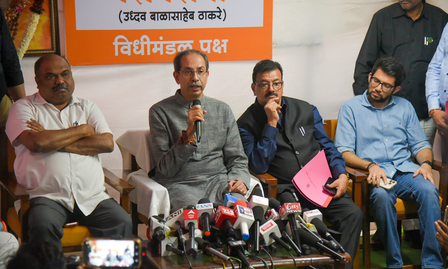
The Saamana editorial sharply criticised the State Election Commission (SEC) for its perceived “inaction”, describing the body as being in a state of “slumber” while instances of kidnapping, terror, and open money distribution took place across the state.
The editorial claimed that the BJP has started a sole business of winning every election through dishonesty. “After the British, the BJP and its allies have looted the country the most. Elections are fought and won using that very looted money. Furthermore, a significant amount of ‘drug money’ was also used in the election. This raises questions about what our democracy is doing and how the ‘Voter King’ actually votes.”
According to the latest figures from the State Election Commission (SEC), the BJP has emerged as the single largest party, winning over 100 municipal president posts. The Shinde-led Shiv Sena and Ajit Pawar’s NCP have each secured more than 40 seats. In contrast, the combined opposition, including the Congress, Sharad Pawar’s NCP(SP), and Shiv Sena(UBT), managed to secure roughly 60 seats. This result mirrors the “pattern” seen in the recent Assembly elections, where the Mahayuti secured a similar landslide victory, said the editorial.
The Thackeray camp has characterised the elections as a “game of money power”, alleging that in several municipal areas, the “market rate” for a single vote ranged from Rs 4,000 to Rs 10,000. In more competitive zones, it is claimed that the BJP pushed the rate as high as Rs 20,000 to Rs 25,000 per vote, leading to internal friction within the ruling alliance.
A specific incident was reported in Sindhudurg, where a public spat broke out between Shinde-faction MLA Nilesh Rane and BJP State President Ravindra Chavan over the distribution of funds.
“Reports of coercion and electoral malpractice and voter intimidation in particular have surfaced from multiple districts. In Dharmabad (Nanded), allegations emerged that BJP office-bearers detained nearly 1,500 voters, including women, in a marriage hall to force them to accept bribes ranging from Rs 2,000 to Rs 4,000. Those who refused were reportedly threatened. In Ambernath, police investigations were launched into allegations of bogus voting involving over 200 women brought in from neighbouring areas. In Panvel, discrepancies in voter lists were flagged, including one instance where 268 voters were allegedly listed with the same father’s name,” said the editorial.
The Thackeray camp has cited the local body elections held in the neighbouring state of Telangana, where the State Election Commission did not use EVMs but conducted on a ballot paper, resulting in a crushing defeat for the BJP.
“In Telangana’s local bodies, the Congress made a strong surge and secured a major victory. Similarly, in Punjab’s local body elections, AAP surged ahead, leaving both the BJP and Congress behind. In both these states, despite the BJP playing a heavy game of money, the voters were not bought,” it said.
The editorial observed that the way the elections are conducted and fought in Maharashtra raises a serious question of the integrity of the democratic process.
As the state moves toward the next major electoral battle — the BMC elections in January 2026 — the questions regarding electoral transparency and the influence of wealth in Maharashtra’s politics will continue to intensify.
–IANS
sj/dpb