
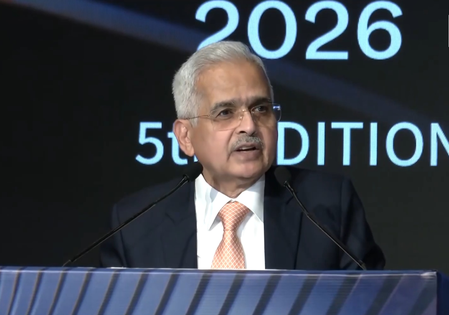
New Delhi, Oct 4 (IANS) India’s broad range of economic reforms rolled out over the past decade have created stronger institutions, macroeconomic stability and led to investment in productive sectors, which have made the country resilient amid successive global shocks that have slowed the world economy, Principal Secretary to the Prime Minister, Shaktikanta Das, said on Sunday.
Addressing the Kautilya Economic Conclave here, Das, a former Reserve Bank of India Governor and former Economic Affairs Secretary in the Union Finance Ministry, said that key reforms implemented in the last 10 years were not designed as one-off measures, but as systemic buffers that enabled the economy to absorb disruptions and recover rapidly.
He highlighted flexible inflation targeting, the introduction of the Goods and Services Tax, the expansion of digital payments, and banking sector reforms among the key reforms that have strengthened India’s economy.
Das said India’s performance stood out against a global backdrop marked by geopolitical uncertainty, trade fragmentation, technological restrictions, energy-price volatility and high public debt in advanced economies.
He said that India’s real GDP grew 7.8 per cent in the first quarter of 2026-27, supported by strong domestic demand and investment, and the country is within “striking distance of 8 per cent growth.” He cited the above 8 per cent growth recorded over the four quarters from July-September 2025 to April-June 2026-27 to back his argument.
Das identified macroeconomic stability as the second major pillar of India’s resilience. The flexible inflation-targeting framework rolled out in 2016 enabled India to navigate successive shocks including the Covid pandemic, the Russia-Ukraine war and conflicts in West Asia, he noted.
He further stated that the government’s policy of sustained fiscal consolidation without compromising on growth-supporting expenditure had helped to stabilise the economy. The tax reforms, including GST, which created an integrated national market, reduced cascading taxes, and expanded formalisation of the economy.
He highlighted the restoration of the health of the country’s banking sector as another “defining feature” of India’s resilience.
Das underscored that large-scale spending on transport and logistics, backed by initiatives such as PM Gati Shakti, the National Logistics Policy, Sagarmala and UDAN, had reduced economic friction and strengthened the foundation for investment-led growth.
India has also diversified its energy base across fossil fuels, renewables, biofuels and nuclear energy, making the economy better positioned to withstand external energy shocks, he added.
Das said India was also witnessing a “manufacturing resurgence”, supported by production-linked incentives, semiconductor investments, automation and Industry 4.0 technologies.
He identified artificial intelligence, deeper financial markets, strategic self-reliance, sustainable development and human capital as the five areas that could define the next phase of India’s growth. Sustaining the reform momentum will be very critical as India’s objective was not simply to grow rapidly, but to grow sustainably and resiliently over the long term, he added.
–IANS
sps/vd