
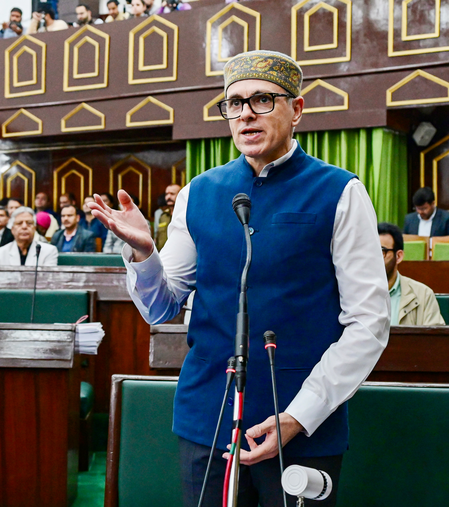
Jammu, Feb 10 (IANS) Jammu and Kashmir Chief Minister, Omar Abdullah said on Tuesday that the union territory government plans to fully utilise the abeyance of the Indus Water Treaty (IWT) to implement various water infrastructure projects.
The issue of many defunct tubewells and other projects of water resources was raised by BJP MLAs including former minister, Sham Lal Sharma in the Legislative Assembly during Question Hour.
Admitting that short-term solutions to the water problems in Jammu is like covering a wound with a band aid as Sham Lal Sharma had rightly said, CM Omar Abdullah told the Assembly that the government must work on plans that look at water needs for the next 30 to 50 years since the traditional water resources would not suffice to meet the future needs.
The chief minister recalled that during the coalition government of NC and Congress, when Sharma was a minister, a proposal to supply water to Jammu city from Chenab river could not be implemented because of the IWT.
“That project was sent to the Asian Development Fund through the Economic Reconstruction Agency (ERA), but approval was denied due to IWT constraints”, CM Omar recalled.
He told the House that since the IWT is under abeyance at present, there is an opportunity revisit the Chenab River water supply project for Jammu city.
“Our government is working closely with the Centre to take full advantage of the abeyance of the IWT.
“We are working with the Centre on two major projects — the Tulbul Navigation Barrage on Jhelum river near Sopore in north Kashmir and lifting water from the Chenab river in Akhnoor to provide water to Jammu city.
“We are hopeful of receiving approval for both the projects soon, after which work will begin,” CM Abdullah said.
It may be mentioned here that the IWT was signed by India and Pakistan on September 19,1960.
According to the treaty, three major rivers of Punjab i.e. the Sutlej, Ravi and Beas were ceded to India while three major rivers in Jammu and Kashmir, Indus, Jhelum and Chenab were ceded to Pakistan.
India could fully utilise the water of three rivers ceded to it, but of the three rivers ceded to Pakistan, no dam or other barrage to obstruct water could be made on these rivers in Jammu and Kashmir.
Only run-of-the-river projects with limited installed hydropower capacity could be constructed in Jammu and Kashmir.
The IWT, therefore, put brakes on the possibility of Jammu and Kashmir utilising the full potential of Indus, Chenab and Jhelum rivers.
After the terror attack in Pahalgam on April 22 last year in which 26 innocents including 25 tourists and one local Pony owner were killed by Pakistan-backed LeT terrorists, India announced its decision to suspend IWT and the suspension continues at present.
–IANS
sq/rad