
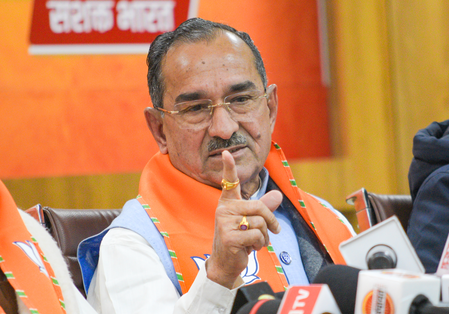
Jaipur, March 19 (IANS) The Central government on Thursday submitted a detailed and fact-based response to the issue raised by Rajya Sabha MP Madan Rathore during Zero Hour on December 12, 2025, regarding the need for regulatory provisions to curb the spread of obscene and harmful “reels” on social media platforms.
In his reply, Union Minister of State for Electronics and Information Technology and Commerce and Industry Jitin Prasada stated that India’s existing legal framework — comprising the Information Technology Act, 2000, and the Information Technology (Intermediary Guidelines and Digital Media Ethics Code) Rules, 2021 — is robust and fully capable of addressing misuse of social media platforms.
He emphasised that the government remains committed to ensuring a safe, responsible, and lawful digital ecosystem, while continuously taking concrete steps to tackle emerging cyber challenges.
Highlighting key provisions, Rathore noted that the IT Act, 2000, includes stringent penal measures for cyber offences such as identity theft, cheating by personation, violation of privacy, publication or transmission of obscene and sexually explicit material, child sexual abuse material, cyber terrorism, and government-authorised blocking of unlawful content.
He further stated that under the IT Rules, 2021, social media intermediaries are legally obligated to exercise due diligence to prevent the dissemination of unlawful, obscene, misleading, or harmful content, failing which they risk losing legal immunity and becoming liable under the law.
Rathore also pointed out that intermediaries are required to remove unlawful content within a stipulated timeframe upon receiving court orders or directions from authorised government agencies.
Additionally, ‘Significant Social Media Intermediaries’ — those with more than 5 million users — must appoint key officials, including a Grievance Officer, Chief Compliance Officer, and Nodal Contact Person in India, to ensure round-the-clock coordination with law enforcement agencies.
The government has also established Grievance Appellate Committees to strengthen user grievance redressal mechanisms.
He further noted that amendments to the IT Rules, effective February 20, 2026, introduce comprehensive measures to tackle emerging threats such as deepfakes and synthetically generated information (SGI). These include clearer definitions of digital content, mandatory labelling and metadata requirements, periodic user awareness initiatives, stricter timelines for content removal, and enhanced due diligence frameworks to curb the spread of misleading or harmful material.
Appreciating the government’s detailed and forward-looking response, Rathore said that decisive action against obscene and harmful content on social media is the need of the hour.
He emphasised that the strengthened legal provisions will enhance platform accountability while safeguarding citizens — especially youth and children — from digital risks.
Commending the leadership of Prime Minister Narendra Modi, Rathore stated that India is rapidly progressing towards a secure, transparent, and responsible digital ecosystem.
He reiterated that the government’s vision is to ensure that the internet is used in a lawful, ethical, and socially beneficial manner, thereby empowering the nation’s digital future.
He expressed confidence that such proactive and forward-looking policies will further enhance India’s global standing in cybersecurity.
–IANS
arc/pgh