
Srinagar, Dec 4 (IANS) Intense cold wave continued across Kashmir Valley on Thursday as minimum temperature remained several notches below the freezing point.
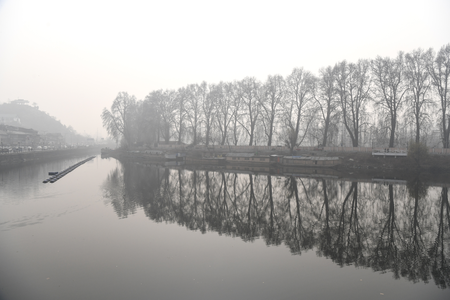
The morning fog and clear night sky added to the chill factor in Srinagar city this morning as pedestrians and motorists moved out with caution to negotiate the slippery streets and roads in the city.
The Meteorological (MeT) Department officials said the minimum temperature was minus 4 degrees Celsius in Srinagar city, while it was minus 4.8 degrees Celsius in Pahalgam and minus one in Gulmarg.
“Jammu city had 8 degrees, Katra town 8.4, Batote 4.7, Banihal 2.1 and Bhaderwah 0.4 as the minimum temperature today. Except for a feeble western disturbance (WD) causing light snowfall in the higher reaches, there is little possibility of rain/snow in J&K till December 10. Given the prevailing weather conditions, the minimum temperature is likely to drop further in the coming days,” the MeT Department officials said.
In Srinagar city, the sun continued its ineffectual battle with the cold to warm up the atmosphere, though it gave little relief to locals fighting the bitter cold, especially in mornings and evenings.
Except for the office-goers, everybody seen on the road is wearing the traditional tweed overgarment called the ‘Pheran’. In rural areas, it is common to see people holding an earthen firepot woven in a willow wicker basket called the ‘Kangri’.
The Kangri is filled with live charcoal and held under the Pheran to warm up the body in cold weather. People in urban and rural areas use the leaves of the ‘Chinar’ tree to make charcoal to be used during the winter months. Although modern gadgets like electricity and fuel-run central heating are used by the affluent Kashmiris to ward off the winter cold, for the average Kashmiri, the Pheran and the Kangri remain the best bet to keep the body warm in the winter months.
The 40-day-long period of harsh winter cold called the ‘Chillai Kalan’ begins on December 21 and ends on January 30 each year. During this period of extreme winter cold, water bodies in the Valley freeze and people have to battle with water taps in the morning to de-freeze them.
The gap between the maximum and the minimum temperature becomes very narrow during the Chillai Kalan as the night temperature drops between minus 5 to minus 7 degrees Celsius, while the day temperature rarely gets into the double digits.
–IANS
sq/dpb