
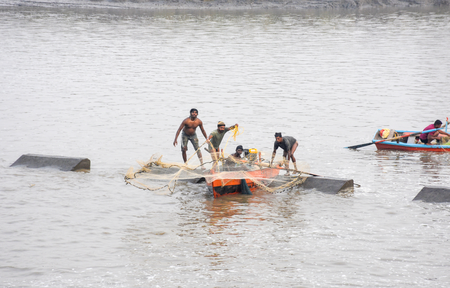
New Delhi, April 6 (IANS) India’s fish production has more than doubled over 10 years to 197.75 lakh tonnes in 2024-25 from 95.79 lakh tonnes in 2013-14, making it the second largest producer of marine products in the world, according to a factsheet put out by the Central government on Monday.
Collectively, fisheries-related schemes implemented since 2014-15 have generated an estimated 74.66 lakh direct and indirect employment opportunities, underscoring the sector’s expanding role in inclusive and sustainable economic growth, the official statement said.
Concurrently, seafood exports expanded significantly, reaching Rs 62,408 crore in FY 2024-25. Frozen shrimp remains the dominant export commodity, with the US and China serving as key markets, highlighting the sector’s expanding scale and growing global competitiveness.
India now accounts for around 8 per cent of global fish output, and with the Union Budget 2026-27 earmarking the highest-ever total annual support of Rs 2,761.80 crore for the sector, the country’s fish production is poised to accelerate further.
Of this total outlay, Rs 2,530 crore is earmarked for implementation through targeted government schemes, including financial assistance, capital subsidies, insurance coverage, capacity-building initiatives, infrastructure development, and welfare support mechanisms designed to directly benefit fishers and fish farmers.
PMMSY, launched in 2020, continues to be the central pillar of fisheries development, with an allocation of Rs 2,500 crore in 2026-27. The comprehensive scheme focuses on production enhancement, infrastructure, and value chain development. Furthermore, the Modern Aquaculture push under PMMSY (2021-22) and Pradhan Mantri Matsya Kisan Samridhi Sah-Yojana (PM-MKSSY) (2023–24) emphasised formalisation, insurance, and financial inclusion.
The Kisan Credit Card (KCC) for fisheries has also improved access to institutional credit, with benefits under the scheme reaching 4.39 lakh fishers. Insurance coverage has been extended to 3.3 million beneficiaries, and livelihood support has benefited about 7.44 lakh fisher families.
The fisheries sector is a critical contributor to India’s economy, supporting the livelihoods of nearly three crore people, particularly among marginalised coastal and inland communities.
Reflecting its growing structural significance in the economy, fisheries account for nearly 7.43 per cent of Agricultural Gross Value Added (GVA), the highest share among the agriculture and allied sectors. This growing prominence is further reinforced by sustained policy prioritisation.
Since the launch of the Blue Revolution in 2015, the sector has transitioned from traditional practices toward a more organised, technology-driven, and value-chain-oriented framework aligned with the Sustainable Development Goals (SDGs). Policy interventions have prioritised integrated value chain development across the marine, inland, and aquaculture segments. Investments in fishing harbours, landing centres, cold-chain logistics, processing infrastructure, deep-sea vessels, and advanced aquaculture systems have strengthened export competitiveness and value addition.
As per the Economic Survey 2025-26, collective institutions have been strengthened through the formation of 2,195 Fisheries Farmer Producer Organisations (FFPOs), supported by an investment of Rs 544 crore, to improve market access and financial inclusion.
Additionally, as of January 2026, nutritional and livelihood support during fishing ban and lean periods, benefiting approximately 4.33 lakh fisher families with an outlay of Rs 1,681.21 crore, has reinforced income stability and social protection.
–IANS
sps/dpb