
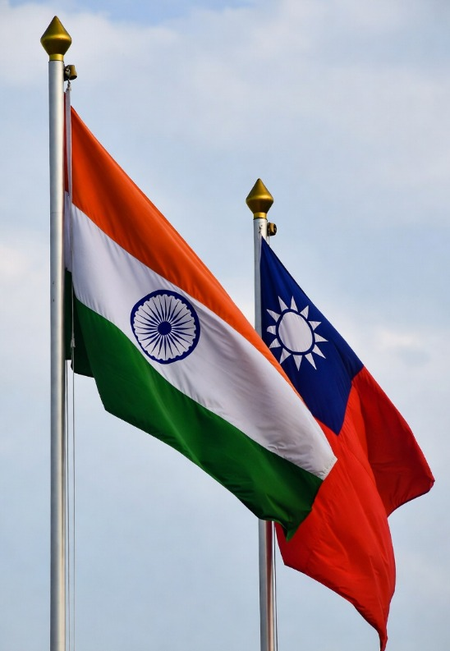
New Delhi, Feb 11 (IANS) India-Taiwan relations are evolving from cautious commercial relations into a structured partnership that covers technology, labour mobility and supply chains.
India has positioned Taiwan as a key partner in its industrial transformation and in mitigating geopolitical supply chain risks by aligning its Act East Policy with Taiwan’s New Southbound Policy. Consequently, India’s Taiwan policy is increasingly shaped by technological security, supply chain resilience, and strategic considerations in the Indo-Pacific, rather than being solely influenced by China, according to an article published by the Taiwan-based Organisation for Research on China and Asia.
“Historically, New Delhi’s engagement with Taipei was a cautious balancing act, often hamstrung by India’s territorial sensitivities with Beijing and a reactive cross-strait policy,” the article states.
However, what was once a cautious and largely commercial relationship is evolving into a structured partnership spanning technology, labour mobility, education and supply chains, widening India’s strategic bandwidth. By strategically converging India’s Act East Policy (AEP) with Taiwan’s New Southbound Policy (NSP), India increasingly views Taiwan as a capability provider that can support domestic industrial transformation and reduce exposure to geopolitical supply shocks.
India’s Taiwan policy is no longer purely derivative of its China calculus; it is increasingly shaped by technological security, supply chain resilience and the strategic posturing in Indo-Pacific geopolitics.
The complementarity between Taiwan’s technological expertise and India’s market scale supports the emergence of a more resilient regional economic structure, which is less susceptible to China’s supply chain dominance, the article states.
It highlights the signing of the Talented Labour Agreement between Taipei Economic and Cultural Center (TECC) and the Mizoram government in January 2026, as a signal that the India-Taiwan partnership has moved beyond mere economic rhetoric into deep structural integration.
The establishment of the third Taipei Economic and Cultural Center (TECC) in Mumbai in 2024 exemplifies a carefully calibrated expansion of engagement despite Beijing’s sensitivities vis-a-vis Taiwan. India has consistently argued that its policy on Taiwan is “clear and consistent”.
Similarly, several track dialogues between India and Taiwan aim to normalise Taiwan’s participation in non-sensitive strategic domains without crossing the threshold of formal security cooperation. Such dialogues aim to address broader Indo-Pacific challenges, focusing on maritime governance, cybersecurity and supply chain resilience.
From an Indo-Pacific perspective, these dialogues support Taiwan’s role as a de facto economic partner and a functional stakeholder. By fostering cooperation in non-sensitive but strategically vital domains, it allows regional actors to build a resilient, rules-based order that safeguards maritime commons and high-tech ecosystems without the immediate need for formal diplomatic realignments, the article added.
–IANS
sps/dpb