
Islamabad, July 18 (IANS) Following Islamabad’s air strikes on the Afghan provinces of Kunar, Paktia, and Paktika in late June, India emerged as the only country to denounce the strikes publicly. New Delhi still continues to condemn Pakistan’s cross-border strikes in Afghanistan at the United Nations, a report has highlighted.
Pakistan was widely regarded as the Taliban’s closest ally and principal backer from 1996 until the group’s return to power in Kabul in August 2021. However, relations between the two have since deteriorated, largely over the issue of the Tehreek-e-Taliban Pakistan (TTP). Islamabad alleges that the TTP operates from sanctuaries inside Afghanistan to carry out attacks in Pakistan, a charge the Taliban reject, insisting that the militant group is Pakistan’s internal problem, according to a report in The Diplomat.
The report noted that New Delhi’s approach towards the Taliban has seen a noticeable strategic recalibration since early 2025. It added that this deepening engagement has coincided with the continuing tensions between Pakistan and Afghanistan.
India’s diplomatic engagement with the Taliban has gathered significant momentum over the last year, particularly after the United Arab Emirates (UAE) facilitated a meeting in Dubai between Foreign Secretary Vikram Misri and Taliban Foreign Ministry Amir Khan Muttaqi on January 8, 2025.
“That meeting marked a major diplomatic milestone, as the relationship between New Delhi and Taliban-controlled Kabul began to take a positive turn,” the report noted.
Ahead of the January 2025 meeting, the then Ministry of External Affairs’ (MEA) Joint Secretary J P Singh was the senior-most Indian official to have held discussions with Taliban officials, including Muttaqi and Defence Minister Mohammad Yaqoob, in November 2024.
In October 2025, Muttaqi travelled to India for a six-day visit, marking the first trip by a senior Taliban minister to India.
“For Muttaqi’s visit to New Delhi, a UN committee temporarily lifted a travel ban on Muttaqi. After his visit, India handed over the Afghan Embassy in New Delhi to the Taliban and sent a charge d’affaires to its former mission in Kabul. Then the Taliban’s senior foreign ministry official, Mufti Noor Ahmad Noor, arrived in New Delhi in January 2026 to assume responsibility as the charge d’affaires of the Afghan Embassy,” the report noted.
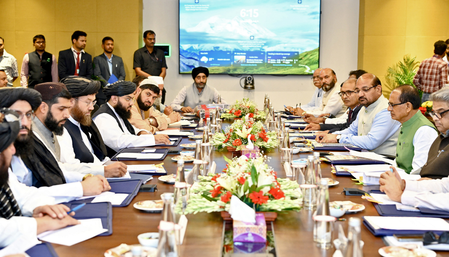
Taliban Minister of Agriculture, Irrigation and Livestock Mawlawi Ataullah Omari visited India with a high-level delegation between July 7 and 12, marking the fourth ministerial-level visit during the last nine months.
According to the MEA, the series of visits is “reflecting the continued momentum in bilateral engagement.”
Highlighting the deteriorating ties between Islamabad and Kabul, The Diplomat said, “For decades, Pakistan maintained a policy of ‘strategic depth’ in Afghanistan, focused on cultivating a friendly government in Kabul in order to secure its western border. However, since the Taliban’s return to power, Pakistan’s policy seems to have backfired, as the Taliban regime tries to assert its independence. The Taliban refuse to recognise the Durand Line as a permanent international border and reject Pakistan’s interference in Afghan affairs.”
–IANS
scor/ksk/as