
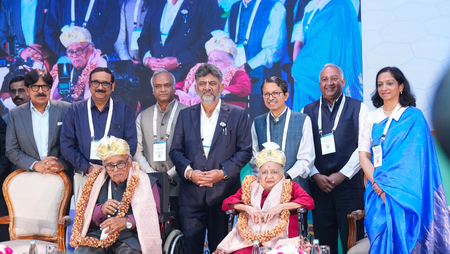
Bengaluru, Aug 4 (IANS) Karnataka Chief Minister, D.K. Shivakumar, on Tuesday said the state is determined to lead the next wave of technological transformation by positioning Bengaluru as a global hub for deep technologies, including nanotechnology, Artificial Intelligence (AI), semiconductors, biotechnology and quantum technologies.
Inaugurating Bengaluru INDIA NANO 2026, India’s premier international nanotechnology conference and exhibition in Bengaluru, CM Shivakumar said Karnataka’s strong ecosystem of premier research institutions, startups, multinational R&D centres and universities gives it a unique advantage to emerge as the world’s leading destination for deep-tech innovation.
“Nanotechnology is no longer confined to research laboratories. It has become a foundational technology transforming healthcare, electronics, energy, agriculture, mobility, aerospace, defence and advanced manufacturing,” he said.
The chief minister said the future would be shaped by the convergence of AI, nanotechnology, biotechnology, quantum technologies, semiconductors and advanced materials, adding that Karnataka intends to remain at the forefront of this technological revolution.
Highlighting Bengaluru’s scientific legacy, CM Shivakumar recalled the historic meeting between industrialist Jamsetji Tata and Swami Vivekananda aboard a ship from Japan to the United States in 1893. Their discussions on scientific research and nation-building eventually led to the establishment of the Indian Institute of Science (IISc), he said.
He noted that the vision became a reality with the support of the erstwhile Kingdom of Mysore, where Maharaja Krishna Raja Wadiyar IV donated around 370 acres of land in Bengaluru and extended financial and infrastructural assistance for the institute.
“Today, nations are competing not merely for investments but for scientific leadership. Whoever leads in advanced materials, nanoelectronics, semiconductor technologies and AI-driven manufacturing will shape the global economy of the coming decades. Karnataka intends to be among those leaders,” he said.
The chief minister said the state government is committed to creating an ecosystem where scientific ideas move rapidly from laboratories to industries and from research papers to commercial products through greater collaboration between academia, industry and startups.
He said nanotechnology has the potential to revolutionise healthcare through targeted drug delivery and precision medicine, improve agriculture with smart fertilisers and efficient water management, and enable cleaner energy, stronger infrastructure and sustainable manufacturing.
Calling for greater innovation, Shivakumar urged global companies to move beyond routine operations in Bengaluru.
“The GCCs of the future should file patents here, not merely close tickets here,” he said, while appealing to academic institutions to focus more on patenting innovations and partnering early with industry to solve real-world problems.
“Bengaluru has put India on the world IT map. It is now time to put India on the world deep-tech map,” he added.
He also paid tribute to Bharat Ratna Professor C.N.R. Rao for his lifelong contribution to scientific excellence and said his vision continues to inspire generations of researchers.
Addressing young scientists and students, the chief minister urged them to dream big and pursue challenging scientific problems, assuring them of the government’s support.
He also stressed that technological advancement must remain human-centric by improving quality of life, promoting sustainable development, generating employment and protecting the environment.
Shivakumar concluded by expressing confidence that while Bengaluru had already established itself as India’s Silicon Valley through software innovation, its next chapter would be written through deep technologies such as nanotechnology, semiconductors, advanced manufacturing, quantum science and artificial intelligence.
He formally inaugurated Bengaluru INDIA NANO 2026 and congratulated Karnataka Science and Technology Promotion Society (KSTePS), Jawaharlal Nehru Centre for Advanced Scientific Research, the Department of Science and Technology, scientists, industry partners and organisers for hosting the event.
–IANS
mka/rad