
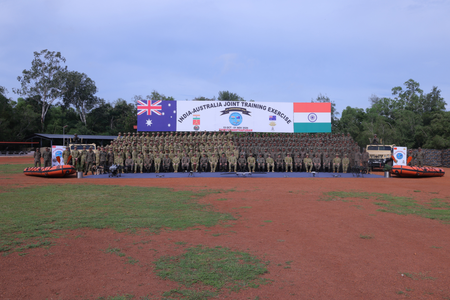
New Delhi, Oct 19 (IANS) The 5th edition of the India-Australia Joint Military Exercise AUSTRAHIND 2026 commenced on Monday at the Foreign Training Node, Thiruvananthapuram, Kerala, focusing on coordinated operations in coastal and island environments, surveillance and reconnaissance, said the Ministry of Defence.
The exercise, being conducted from October 19 to November 1, will witness the participation of approximately 120 personnel each from the Indian Army and the Australian Army. The fourth edition was held at Irwin Barracks, Perth, Australia, from October 13 to 26, 2025.
The Indian Army contingent comprises troops from the Garhwal Rifles, along with personnel from other arms and services, while the Australian Army contingent comprises troops from 13 Brigade.
According to a statement by the Ministry, the exercise will be conducted on the theme “Joint Sub-Conventional Operations in Island and Coastal Environment under Chapter VII of the UN Mandate”.
“It is aimed at enhancing interoperability, jointmanship and operational coordination between the two armies while developing a common understanding of tactics, techniques and procedures for operations in island and coastal terrain,” read the statement.
During the exercise, troops of both armies will undertake joint planning, tactical drills and combat-oriented training in realistic operational conditions, including aerial and maritime dimensions.
“The training will focus on coordinated operations in coastal and island environments, surveillance and reconnaissance, protection of vital installations and response to Humanitarian Assistance and Disaster Relief contingencies, besides exchange of professional experience and best practices. As a first, an observer delegation from New Zealand will also be participating in the exercise,” stated the Ministry.
“Exercise AUSTRAHIND 2026 will further strengthen military-to-military cooperation, interoperability and mutual trust between India and Australia. It will reinforce their shared commitment towards peace, stability and security in the Indo-Pacific region,” it added.
–IANS
ksk/dan