
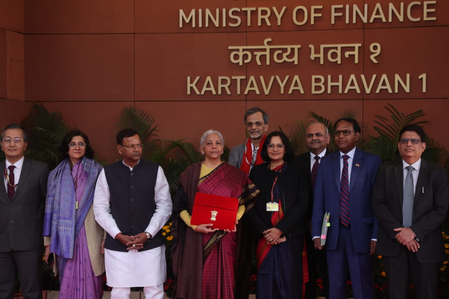
New Delhi, Feb 1 (IANS) The government is set to present the Union Budget 2026-27, with Part B of the Budget document likely to carry unprecedented detail and emphasis on economic direction and policy reforms for the first time — sharing directional cues on growth priorities and the country’s emerging role in a shifting global economy.
The Union Budget is divided into two parts — A and B — with the latter part serving primarily as a shorter segment focused on tax proposals and select updates, while part A of the Budget carries most of the detailed policy announcements.
With this year’s Budget, the government is overhauling the structure of the Finance Minister’s speech, as per officials.
Finance Minister Nirmala Sitharaman is likely to devote unprecedented detail to Part B, which is expected to serve not just as a tax policy outline but as a broader statement on India’s economic direction.
According to officials, Part B will articulate both short-term priorities aimed at immediate economic stability and long-term objectives that will shape India’s growth trajectory.
The segment is also likely to present a roadmap to boost India’s local strengths on the global stage, highlighting sectors where the country has competitive advantages, while projecting the surprise sectors.
The emphasis this year is likely to be on defence, infrastructure, capex, power, and higher growth in affordable housing, apart from balancing social welfare with fiscal prudence. Besides, policymakers will also balance growth priorities with fiscal discipline amid heightened global uncertainty.
The Budget is likely to strike a deft balance of sustaining growth momentum and maintaining fiscal consolidation. It also needs to address near-term challenges emanating from unprecedented geopolitical flux, said economists.
FM Sitharaman will present the 15th Budget of the Prime Minister Narendra Modi government. This will also be the second full Budget since the National Democratic Alliance (NDA) came to power for a third consecutive term in 2024.
Sitharaman is also the first woman finance minister of the country to present the Budget in Parliament for the ninth consecutive time. While the FY26 Budget was more tilted towards stimulating middle-class consumption with tax reliefs, the FY27 Budget’s approach to stimulating consumption is likely to be selective.
–IANS
na/dpb