
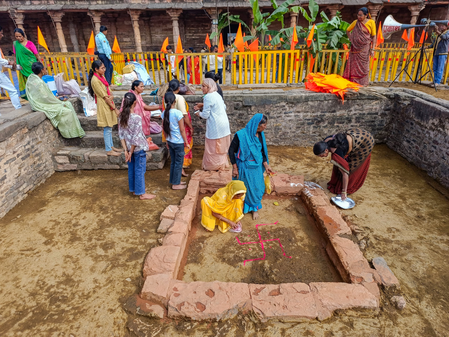
Bhopal/Indore, Feb 16 (IANS) A crucial hearing in the decades-old dispute over Dhar’s Bhojshala Temple-Kamal Maula Mosque Complex will be held on Monday at the Indore Bench of the Madhya Pradesh High Court.
On the very first day, the Archaeological Survey of India’s detailed 98-day scientific survey report is to be formally presented in court for the first time, with its findings shared directly with representatives of both Hindu and Muslim parties.
The proceedings, directed by the Supreme Court, are to be heard by a Division Bench comprising Justice Vijay Kumar Shukla and Justice Alok Awasthi, where the case is listed as item number 62.
The 11th-century monument, officially protected and documented by the ASI as the Bhojshala Temple-Kamal Maula Mosque Complex, has remained a focal point of competing religious claims.
For the Hindu community, the site is the sacred Bhojshala, a grand temple dedicated to Goddess Saraswati established by King Bhoj of the Parmar dynasty. Historical evidence cited includes intricately carved pillars, inscriptions in Sanskrit and Prakrit, and accounts portraying it as a celebrated hub of Sanskrit scholarship and spiritual learning during that era.
In contrast, the Muslim community regards the complex as the Kamal Maula Mosque, rooted in centuries of continuous prayer traditions. Records show structural alterations made in the medieval period, and parts of the site feature prayer halls constructed in styles characteristic of Islamic architecture.
Over recent decades, friction has intensified, especially on occasions when Vasant Panchami and Friday prayers fall on the same day.
Local authorities have repeatedly attempted to manage access and maintain harmony between the two communities, yet the underlying disagreement has persisted through ongoing court battles.
The ASI survey, ordered by the High Court, involved an in-depth scientific examination of the monument’s architectural strata, inscriptions, construction techniques, and other physical evidence.
Its conclusions are expected to carry substantial weight in determining the site’s historical identity and guiding future arrangements for worship and visitation.
This latest court development unfolds at the delicate crossroads of heritage, devotion, and jurisprudence.
The outcome of the hearing could represent a defining moment in the long-standing Bhojshala controversy, potentially influencing not only day-to-day practices at the Dhar site but also the broader framework for addressing similar disputed monuments throughout India.
–IANS
sktr/rad