
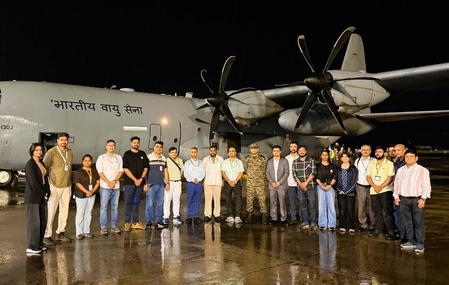
Gandhinagar, Aug 30 (IANS) A 10-member forensic team from Gujarat’s National Forensic Sciences University (NFSU) has begun assisting Nepalese authorities in identifying victims of the devastating floods and landslides along the Nepal-Tibet border, with DNA experts now working on the ground as the number of dead and missing continues to rise.
The NFSU team, led by Dr Bhargav Patel, head of the Centre of Excellence in DNA Forensics at the university’s Gandhinagar campus, reached Nepal after leaving Gujarat on Saturday night.
It has begun the Disaster Victim Identification (DVI) process in coordination with local authorities and under the joint guidance of India’s Ministry of External Affairs and Ministry of Home Affairs.
The deployment is aimed particularly at identifying unidentified bodies and helping families establish the identities of relatives who remain missing following the disaster.
“Disaster Victim Identification” will allow DNA samples from recovered bodies or human remains to be matched with samples from relatives of missing people, allowing authorities to establish identities where visual or other conventional methods are not possible.
The latest update comes as Nepal and Tibet continue to deal with the aftermath of the catastrophic flooding triggered by a glacial collapse and landslide in the Himalayan region on August 26.
The death toll reached about 750 by Sunday, while more than 3,000 people remained missing, according to the latest reports.
Nepal alone has reported 734 deaths and 2,498 people missing, while China has reported 16 deaths and 546 missing in Tibet. The disaster has posed particular difficulties for victim identification.
Bodies have been recovered downstream, and Nepalese authorities have reportedly been using hospitals in several districts to preserve and identify unidentified remains.
The scale of the operation has also created shortages in facilities needed to store bodies while identification and DNA testing are carried out.
NFSU said its Centre of Excellence in DNA Forensics in Gandhinagar has advanced equipment and sufficient DNA kits to undertake victim identification work.
The university’s experts will therefore support the identification process in coordination with Nepalese authorities rather than conducting the operation independently.
The latest deployment follows India’s broader assistance to Nepal after the disaster.
The Ministry of External Affairs has established a 24-hour control room to coordinate assistance and provide information concerning Indian nationals affected by the floods.
Rescue operations remain under way, with thousands of soldiers and police personnel deployed in Nepal. Search teams are facing difficult terrain, damaged roads and bridges, continuing rainfall and rising river levels.
More than 900 workers at hydropower projects have also been reported missing, adding another major challenge to the ongoing rescue and identification effort.
The NFSU team is expected to continue its forensic assistance alongside local authorities as recovery operations progress and more human remains are located.
–IANS
mys/uk