
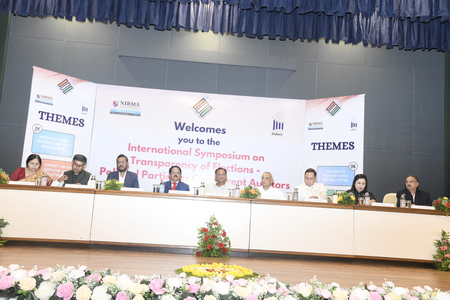
Ahmedabad, July 21 (IANS) Election officials, legal experts and international delegates gathered at Nirma University in Ahmedabad on Tuesday for an international symposium on electoral transparency that focused on the role of political parties as “concurrent auditors” of the election process, with discussions ranging from institutional accountability and technology to public trust in democratic systems.
The thematic symposium, titled “Electoral Transparency: Political Parties as Concurrent Auditors”, was organised by the Office of the Chief Electoral Officer, Gujarat, in collaboration with the India International Institute of Democracy and Election Management (IIIDEM), New Delhi, and other organisations.
The event aimed to examine ways to strengthen transparency, credibility and accountability in electoral processes.
Among those present were Gujarat Chief Electoral Officer Sandeep Sagale, Rajasthan Chief Electoral Officer Naveen Mahajan, Anand Collector Praveen Chaudhary, IAS officer Rinkesh Patel, and election management representatives from the Philippines, Atty. Jovencio G. Balanquit and Atty. Zennia S. Ledesma.
Opening the symposium, Balanquit congratulated India for the continuous and successful conduct of elections in what he described as the world’s largest democracy.
Drawing comparisons between the electoral systems of India and the Philippines, he said: “Maintaining credible electoral rolls, ensuring the presence of political party representatives during polling and vote counting, taking effective action against violations of election laws, and adopting modern technology were all essential elements of a transparent election process.”
He added, “Election authorities alone cannot ensure complete transparency. Political parties, civil society organisations and the media function as watchdogs and auditors in the electoral process.”
He noted that both India and the Philippines recognised the importance of every vote and that transparency must be maintained throughout every stage of elections, regardless of whether voting was conducted through digital, automated or manual systems.
“If the electoral process is not transparent, public trust declines, and democracy becomes weaker. I hope today’s symposium will further strengthen the values of democracy,” Balanquit said.
Rajasthan Chief Electoral Officer Naveen Mahajan said the participation of Booth Level Agents (BLAs), polling agents and candidates’ representatives during the preparation of electoral rolls, polling and counting of votes demonstrated the transparency built into India’s electoral process.
“The Election Commission of India regularly partnered with educational institutions across the country to organise programmes aimed at increasing awareness among young voters and encouraging them to participate in elections by casting their votes,” he noted.
Mahajan also interacted with students during a question-and-answer session on the symposium’s themes and congratulated the Gujarat Chief Electoral Officer’s office and Nirma University for selecting the subject and organising the event.
Addressing the gathering, Gujarat Chief Electoral Officer Sandeep Sagale said the symposium featured five thematic sessions covering institutional frameworks; neutrality and political party-based oversight; continuity and gaps in verification throughout the electoral cycle; transparency and public trust; auditability in technology-driven election management; and accountability through effective monitoring.
He emphasised that the increasing use of technology in election management, including electronic voting systems, digital electoral rolls, result management, and data-driven processes, had created new opportunities while also introducing challenges related to auditability, cybersecurity, and public confidence.
“In such circumstances, dialogue and the exchange of experiences among election management institutions, political parties, legal experts, academicians and other stakeholders have become increasingly important,” Sagale said.
He said participation by election officials from different Indian states, delegates from the Philippines and representatives of law universities had brought together diverse models and practical experiences on electoral transparency.
According to him, the symposium enabled discussions on strengthening transparency and accountability by combining international experience, administrative practice and academic and legal perspectives.
Sagale also described young people as the foundation of democracy and urged them to participate actively in the electoral process.
“The ideas, experiences and recommendations emerging from the symposium would contribute to a better understanding of existing electoral transparency mechanisms, help identify emerging challenges and opportunities, document best practices from different electoral systems and support the development of evidence-based policy recommendations,” he said.
The symposium was attended by vice-chancellors, registrars, academicians, researchers, legal experts, election management officials and senior journalists from law universities across the country.
–IANS
mys/dan