
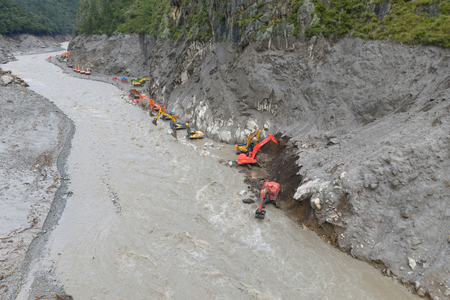
Kathmandu, Sep 9 (IANS) On August 26, a glacier tore loose above the Nepal-Tibet border and sent a wall of ice, rock and water crashing down the Bhote Koshi valley. Within days, Nepal had counted over 1300 people dead and thousands still missing. China, governing the villages on the other side of the same disaster, had counted only a handful.
That gap is not a footnote, it is the story. It shows, in the starkest terms possible, how the infrastructure Beijing calls “green development” in Tibet and the information control it exercises over the same territory are two faces of a single strategy, build fast, say little and let the silence do the rest of the work.
China presents the Tibetan Autonomous Region as a world-class clean-energy frontier, hydropower dams on the Yarlung Tsangpo, solar farms spreading across Shigatse and Gar County and ultra-high-voltage lines carrying power east. India’s Takshashila Institution has tracked several gigawatts of new renewable capacity added since 2013, with sharp jumps of 700 megawatts in 2023, 860 in 2024 and an estimated 2,600 in 2025.
But the same geospatial mapping that recorded this growth also found solar sites sitting near airport infrastructure and in Gar County, within three kilometres of an antenna array associated with signals monitoring. A Washington-based CSIS study calls the resulting pattern a “gray-zone infrastructure strategy” of dams, roads, rail and digital systems that build coercive leverage over India and Nepal without a single shot being fired.
The energy grid does not stand alone. It feeds a network of electrified border villages, microgrids and garrisons that has expanded steadily since 2017. These settlements let China maintain a permanent civilian and military footprint opposite India’s Arunachal Pradesh, Sikkim and Ladakh sectors and they depend on precisely the power infrastructure marketed abroad as a climate initiative.
Reliable electricity at high altitude sustains radar, communications equipment, drones and barracks as easily as it powers a village school. This is the context that matters for what happened next, a region built for permanence and control is also a region built to withstand scrutiny.
When the glacier collapsed, that capacity for control turned toward the disaster itself rather than away from it. Nepal’s side of the border stayed open to journalists, aid workers and independent observers, who filed minute-by-minute accounts from survivors. Tibet’s side did not. Foreign journalists could not travel there independently, images of the destruction at the Gyirong border crossing that briefly appeared online were later removed from Chinese platforms, a pattern confirmed separately by Australia’s ABC and Germany’s ARD.
Radio Free Asia reported that access for independent observers was restricted, leaving the outside world reliant almost entirely on statements from Chinese authorities. As one China scholar put it, everything about Tibet is filtered through a national security lens, so no one reports a death toll until Beijing’s own figure moves even if they have counted more bodies themselves. The five to 538 gaps in official casualties are best read not as evidence that Tibet suffered less, but as evidence that Tibet was allowed to say less.
This is where information control stops being an abstract press freedom concern and becomes a physical safety problem. The Guardian reported that hydrological data from the Tibetan plateau is treated as strategically sensitive and that Nepal lacked a comprehensive real time system for tracking glacial lakes and rivers upstream of its own villages. China’s foreign minister, Wang Yi, has said Beijing shared satellite imagery, hydrological data and warnings about barrier lakes before the flood and no evidence has emerged that information was deliberately withheld to expose Nepal to greater risk.
But intent is beside the point for the families in the Bhote Koshi valley, whether by policy or by habit, a downstream country did not have the early warning tools a fast-moving glacial disaster required. Nepal and China have since agreed to strengthen real time data sharing a tacit admission that the system in place before August 26 was not good enough.
Put together, the pattern is difficult to miss. Energy infrastructure marketed as green development anchors a military presence along a disputed border. That same infrastructure and the political system built to protect it, produces a default of secrecy whenever something goes wrong on the Tibetan side and the region where all of this is happening is precisely the region least able to absorb rapid, opaque construction without ecological cost.
For Nepal, Bhutan, Bangladesh and India the lesson of August 2026 is not that China caused the glacier to collapse. It is that a system built for control, not transparency, will always struggle to give downstream neighbours the warning, the data and the honest casualty count they need and that a “clean energy miracle” built on those terms is not as clean as it is sold to be.
–IANS
scor/as