
New Delhi, Feb 13 (IANS) Commerce and Industry Minister Piyush Goyal on Friday said that India’s recent free trade agreements (FTAs), particularly the interim trade deal framework with the US, have marked a structural shift in how New Delhi engages with the world on trade issues.
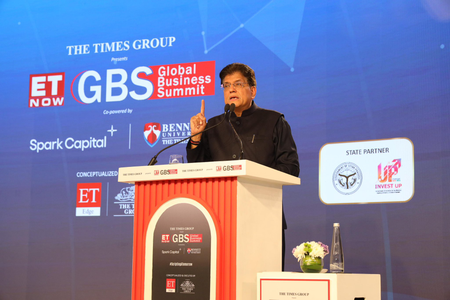
Delivering the keynote address at the ‘ET NOW Global Business Summit (GBS) 2026’ here, the minister reiterated that India has fully protected the interests of farmers while negotiating the trade deal with the US.
The minister told the gathering that when we did the trade deal with the US, “it was very clear that we need to protect our farmers”.
“Therefore, in all the areas in which our farmers have high production or helped the country become self-sufficient, we were able to keep them out of the trade agreement,” he said, adding that “we have fully protected the interests of farmers, possibly over 95 per cent of the local farm produce”.
Goyal further stated that for a long time, they’ve been discussing why India’s textile sector isn’t growing.
“We couldn’t even compete with countries like Vietnam and Bangladesh. Now, with the textile sector open to Europe without any duty, and the United States reducing the reciprocal tariff from 25 per cent to 18 per cent, we can compete with the rest of the world,” he said.
He earlier said that India will receive the same benefits on textiles exports under its interim trade agreement with the US as Bangladesh gained through its own deal. Textile exporters had received assurances of equal treatment with Bangladesh.
At the event, Goyal also underlined that FTAs are rooted in a clear framework. “FTA deals based on 3 principles – Trust, Transparency, and Time-bound certainty.”
The minister cited the India-EFTA agreement as an example of how New Delhi is rewriting the template for trade partnerships. The European Free Trade Association (EFTA) comprises Iceland, Liechtenstein, Norway, and Switzerland.
“Prime Minister Narendra Modi has taken forward the ‘Reform Express’ in mission mode,” he added. “Today, we are fourth largest economy; maybe a couple of years down, we should be the third-largest global GDP,” he said.
–IANS
na/vd