
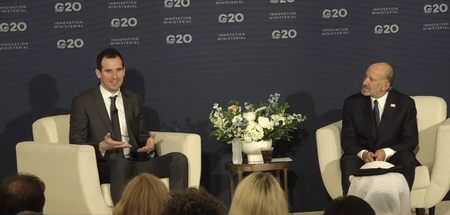
Chapel Hill (North Carolina), Sep 2 (IANS) A conversation with friends more than a decade ago persuaded Anthropic Executive Tom Brown to leave engineering and pursue artificial intelligence (AI), beginning a journey that took him through OpenAI and eventually to the founding of Anthropic.
Speaking during a fireside chat with US Commerce Secretary Howard Lutnick, Brown said he began studying AI in 2014 after friends raised the possibility that machines could achieve human-level intelligence within their lifetimes.
“A few of my friends came to me and they were like, ‘Tom, it seems like we might end up getting human level intelligence from AI within our lifetimes, so in the next 50 years,'” Brown recalled.
The proposition initially sounded far-fetched. But its potential consequences were too important for him to ignore.
“I was like, ‘Wow, that, like, seems kinda crazy, but if it does happen, like, that would be the biggest, most important thing that ever happens to humanity,'” he said.
Brown added that the conversation forced him to consider what distinguished humans and why advances in machine intelligence could prove more consequential than earlier technological revolutions.
“The industrial revolution transformed all of society, but really it was, like, the second most important thing about humans is our bodies,” he said.
“The main thing is our minds.”
Brown then moved away from conventional engineering and began teaching himself about artificial intelligence.
“That got me to think, like, okay, maybe I’ll switch from engineering to try to help out learning about AI,” he said.
“And so I did. I started doing kind of self study on that.”
OpenAI was founded about a year later. Brown said he knew some of the people involved and approached the fledgling organisation to see whether he could contribute.
“I went to see if I could help out in some way,” he added.
“And so I joined, I joined them as, like, one of the first 20 employees, basically, to do engineering work.”
A decisive moment came in 2019 with research into AI scaling laws. The work examined how different combinations of computing power, data and model size affected a model’s capabilities.
Until then, researchers had observed that models improved as they grew and received more computing resources. But Brown said they lacked a clear understanding of the mechanism connecting scale with greater intelligence.
The scaling studies produced what Brown described as a recipe for determining “what exact combinations of compute, data, and model size resulted in a given level of intelligence”.
The findings changed his assessment of how quickly advanced AI could emerge. What had appeared to be a development that might take half a century suddenly seemed much closer.
“That gave us kind of the confidence that this stuff would continue to advance at the rapid rate that it has been, which ended up leading to the founding of Anthropic,” Brown said.
The researchers concluded that the breakthrough could occur “not in 50 years but in, on the order of under 10 years,” he added.
Brown said Anthropic was created with the goal of helping ensure that the accelerating AI transformation benefited society broadly.
“Anthropic is focused on making sure that as we go through this very rapid kind of a, like, AI revolution, things go well for everyone,” he added.
Anthropic was founded in 2021 by former OpenAI researchers, including siblings Dario and Daniela Amodei.
The San Francisco-based company develops the Claude family of artificial intelligence models.
OpenAI was established in 2015 as an artificial intelligence research organisation.
Its release of ChatGPT in late 2022 helped bring generative AI into widespread public use and intensified competition among technology companies developing advanced models.
–IANS
int/lkj/khz