
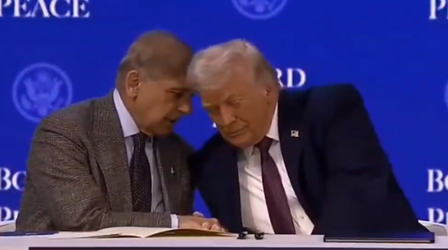
New Delhi, Jan 25 (IANS) It is hard to overlook the irony of the United States establishing a ‘Board of Peace’ that includes Pakistan as a key member.
The visuals from Davos — featuring US President Donald Trump engaged in a close dialogue with Pakistan Prime Minister Shehbaz Sharif — were not merely symbolic; they reflected a troubling disregard for important realities.
Pakistan’s record is neither ambiguous nor disputed. It is a country long accused of sponsoring cross-border terrorism against India that has claimed thousands of lives and displaced lakhs.
The perpetrators of the 26/11 Mumbai attacks emerged from its soil. Osama bin Laden, mastermind of the 9/11 attacks, was found hiding in Abbottabad, a stone’s throw from a major Pakistani military installation.
More recently, the April 22 Pahalgam terror attack once again underscored the persistence of this threat. India has directly faced Pakistan-sponsored terrorism for decades, and the US knows it.
Beyond terrorism, Pakistan’s internal record offers little reassurance. From the brutal suppression of dissent in Balochistan and Khyber Pakhtunkhwa to allegations of rigged elections, compromised courts, military dominance over civilian authority, and systemic persecution of minorities, the country has struggled to uphold even basic democratic norms.
Despite this, it finds a place of prominence on Trump’s Board of Peace.
Trump, while announcing the board, spoke of ending decades of suffering, stopping cycles of hatred, and forging a “beautiful, everlasting and glorious peace”. The sentiment may sound lofty, but it raises a fundamental question: can peace be built without first dismantling terror networks and holding state sponsors (Pakistan) accountable?
The Board of Peace itself appears less like a multilateral initiative and more like a personalised political instrument — one driven by a desire to bypass post-war international institutions and replace them with a US-dominated authority. History suggests that when peace becomes political, caution is not just advisable, but necessary.
India’s scepticism is not born of cynicism but experience. In recent years, New Delhi has watched instability unfold across its neighbourhood — Bangladesh, Sri Lanka, the Maldives, and Nepal — often amid external influences and selective global interventions.
Peace forums that claim neutrality frequently carry hidden agendas, shaping narratives through soft power, moral pressure, and media amplification rather than democratic legitimacy or accountability.
The danger lies not in the pursuit of peace, but in how it is defined and enforced. Many such boards operate outside established multilateral frameworks, presenting simplified versions of complex conflicts, where historical context becomes inconvenient. Accountability, more often than not, is demanded primarily of those willing to engage in dialogue — not those who actively undermine it.
For India, this asymmetry is particularly troubling. Decades of cross-border terrorism, proxy wars, and efforts to internationalise internal security challenges have repeatedly tested its restraint.
The late Prime Minister Atal Bihari Vajpayee’s historic bus journey to Lahore in 1999 was a genuine gesture of peace. The Kargil conflict that followed was a brutal reminder of the risks of misplaced trust.
It is, therefore, legitimate to ask how a ‘Board of Peace’ can include a state that has consistently compromised peace. Has the US forgotten the lessons of Abbottabad, or has strategic convenience overtaken memory? The visible warmth between Trump and Pakistan’s military leadership only deepens these concerns.
India, which gave the world the philosophies of Buddha and Mahatma Gandhi, does not need lectures on peace. It understands peace not as a spectacle but as a responsibility. That is why New Delhi must approach Trump’s invitation to join the Board of Peace with measured caution.
The board’s stated mandate, overseeing the Gaza ceasefire and reconstruction, has already expanded in ambition, with Trump suggesting it could replace the United Nations in resolving global conflicts. Such aspirations, without institutional checks or inclusivity, should concern any serious democracy.
With Pakistan attempting to position itself as a key interlocutor, the risk of it leveraging such platforms to revive its Kashmir narrative is real. India has consistently countered these attempts in the United Nations and other forums, and its diplomacy is capable of doing so again. Yet vigilance remains essential.
Peace that ignores history, excuses terror, and rewards duplicity is not peace — it is merely an illusion. Pakistan is a terror monster, and it is unfortunate that the US has chosen to overlook this reality.
(Deepika Bhan can be contacted at deepika.b@ians.in)
–IANS
dpb/sd/