
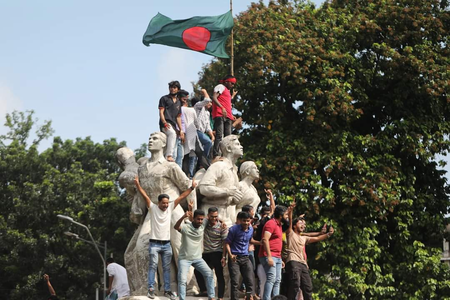
Dhaka, Aug 6 (IANS) The anticipated transformation in behaviour of political parties in Bangladesh and electoral democracy in the country is yet to materialise despite the July 2024 demonstrations even as the political participation of women has gradually diminished in the said period, local media reported citing experts.
The observations were shared during a discussion titled ‘Return of Electoral Democracy in Bangladesh: Reflections and Learnings from 2026’, jointly organised by the BRAC Institute of Governance and Development (BIGD) and BRAC University in Dhaka.
Mahfuj Alam, organiser of Alternatives and former interim government advisor, said sharp ideological rifts led to the breakdown of Bangladesh’s National Citizen Committee’s broad coalition.
“The movement’s attempt at a ‘post-ideological’ middle ground faltered as right-wing positions gained ground and the Left was sidelined. The country reverted to majoritarian politics, failing to build a centrist alternative,” Bangladesh’s leading newspaper ‘The Daily Star’ quoted Alam as saying.
“Instead of reform, factions splintered under the influence of establishment figures and senior advisers, who treated the movement’s collective power as spoils to be divided, undermining the prospects for a sustainable political alternative,” he added.
Addressing the session, BIGD Adviser Mirza M Hassan said Bangladesh is currently witnessing the weakest opposition parties in its history.
“The Awami League is absent from politics, Jamaat lacks confidence, and the NCP remains a very small party,” he stated.
Bangladeshi politician Tasnim Jara said women continue to be subjected to organised digital violence and character assassination in what she described as a “rigged” political system.
She warned that elite-led political transitions often fail to reflect public sentiment, leaving women exposed to coordinated attacks.
Jara stressed the need to dismantle structures that continue to exclude women from decision-making.
Tajnuva Jabeen, an organiser of Alternatives, emphasised the need to build a “minimum common ground” across ideological divides to facilitate peaceful political transitions.
Network for People’s Action founder member Anik Roy said that democracy remains a “luxury item” for many people struggling with economic security in Bangladesh.
“Until we implement economic reforms and build sustainable industries, constitutional changes alone will not establish democracy. We need a system that ensures accountability, transparency, and dignity for every citizen,” he noted.
Sohela Nazneen, researcher at the Institute of Development Studies at the University of Sussex, said women played a key role during the 2024 demonstration but encountered escalating backlash afterwards. She said that the 2026 elections witnessed very limited representation of women, with very few nominated for general seats and continued dependence on reserved seats, The Daily Star reported.
Yasin Shafi, a researcher at Pennsylvania State University, said those involved in political activism continue to face state repression, legal persecution and violence.
He warned that repression remains “cheap” for those in power, allowing partisan violence to become entrenched, adding that only regular competitive elections and safeguards for opposition activists can deliver a genuine democratic transition.
–IANS
scor/ksk/as