
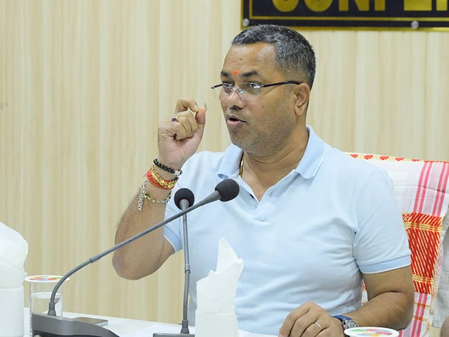
Guwahati, Nov 17 (IANS) Assam Public Health Engineering (PHE) Minister Krishnendu Paul on Tuesday directed officials to ensure that every water supply scheme under the Jal Jeevan Mission (JJM) is fully functional.
He asserted that the term “partially functioning” should not be used as an excuse for incomplete implementation.
Chairing review meetings in Darrang and Udalguri districts to assess the progress of Jal Jeevan Mission 2.0 and Swachh Bharat Mission-Gramin (SBM-G) 2.0, Paul emphasised the need to accelerate ground-level implementation and ensure uninterrupted access to safe drinking water for every household.
“Partially functioning” should be avoided, and every water supply scheme must be operational, the minister told officials. He underlined the government’s focus on effective delivery rather than merely completing infrastructure projects.
The first review meeting was held at the District Library in Mangaldai, where the minister reviewed the progress of drinking water and rural sanitation projects in Darrang.
He called for expediting field-level activities and removing bottlenecks affecting the implementation of the schemes.
The meeting was attended by Animal Husbandry and Veterinary Minister and Mangaldai MLA Nilima Devi, Sipajhar MLA Paramananda Rajbongshi, former minister Basanta Das, former MLA and Assam Fisheries Development Corporation Chairman Gurujyoti Das, Darrang District Commissioner Ayushi Jain and other officials and public representatives.
A separate review meeting was subsequently held at the Udalguri District Commissioner’s office to assess the implementation of JJM 2.0 and SBM-G 2.0 in the district.
MLAs Bekan Deka and Maheswar Boro, BTC Executive Member Begum Akhtara, District Commissioner Pulak Patgiri and senior departmental officials attended the meeting.
Paul called for coordinated efforts involving the administration, elected representatives and local communities to strengthen rural infrastructure and ensure timely completion of projects.
He said the PHE Department remained committed to providing drinking water and other essential services to people, reiterating that access to safe drinking water and improved sanitation must reach every household.
–IANS
tdr/brt