
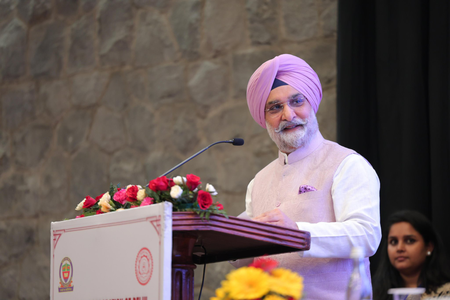
New Delhi, Sep 1 (IANS) Emphasising effective waste management through public participation, Delhi Lieutenant Governor (L-G) T.S. Sandhu on Tuesday called for shifting from a “Waste-to-Landfill” approach to a “Waste-to-Wealth” model.
Inaugurating the “One-Day Brainstorming Workshop on Municipal Solid Waste Management: A Multi-Level/Multi-Stakeholder Strategy towards Circularity”, L-G Sandhu said that with Delhi generating around 13,000 metric tonnes of municipal waste every day, there is a need to adopt modern, sustainable and practical solutions for effective waste management.
The workshop was organised by the Municipal Corporation of Delhi (MCD) in collaboration with IIT Delhi, an official statement said.
The L-G said that scientific and sustainable management of municipal waste is not merely a matter of cleanliness but is closely linked with public health, environmental protection and the quality of life of Delhi’s citizens.
He singled out Indore as a shining domestic example of what disciplined, sustained municipal effort can achieve, and called for its successful model to be studied closely and replicated in Delhi, suitably adapted to the national capital’s scale, density, and local conditions.
The workshop marked the first such institutional collaboration undertaken by the MCD with a premier academic institution on the subject of solid waste management, and came in pursuance of earlier directions issued by the L-G.
Delhi Mayor Pravesh Wahi, Mayor of Indore Pushyamitra Bhargav, MCD Commissioner Sanjeev Khirwar, Additional Commissioner Arun Kumar Mishra, Municipal Councillors, experts from IIT Delhi and the waste management sector, and senior MCD officers, engineers and staff were present on the occasion.
L-G Sandhu emphasised that effective waste management requires collective responsibility and active public participation.
Municipal bodies, public representatives, RWAs, market associations, industries, institutions, experts and citizens must work together to bring about lasting change, with every household standing as an equal stakeholder rather than treating cleanliness as the Municipal Corporation’s responsibility alone.
Wahi said that cleanliness in Delhi is a collective responsibility and must remain a top priority for building a cleaner, healthier and better city.
He highlighted the progress made in recent years, including the clearing of landfill sites, strengthening of sanitation infrastructure and deployment of new machinery.
He also stressed the importance of strict enforcement and said that selected wards should be developed as model wards showcasing best practices in sanitation and waste management.
Indore Mayor Pushyamitra Bhargav underlined the importance of behavioural change and decentralised waste management through initiatives such as Zero Waste Wards, Zero Waste Colonies and Zero Waste Roads, with active participation of residents and local communities.
MCD Commissioner Sanjeev Khirwar said that source segregation, scientific waste processing and resource recovery are among MCD’s key priorities.
He said the focus is to treat waste as a resource by converting organic waste into compost and biogas and recovering and recycling dry waste, thereby moving from waste disposal towards resource recovery and a circular economy.
–IANS
rch/khz