
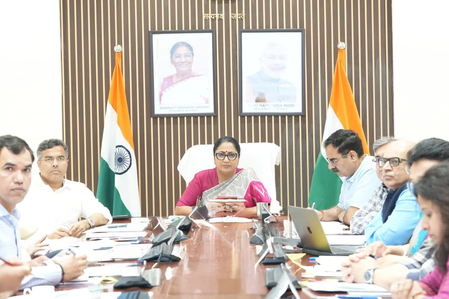
New Delhi, April 3 (IANS) Delhi Chief Minister Rekha Gupta on Friday unveiled an aggressive and wide-ranging strategy to combat air pollution in the capital, signalling tough measures to ease traffic congestion at 62 identified hotspots through time-bound interventions.
Announcing the rollout of the Air Pollution Mitigation Action Plan 2026, she said the initiative builds on the government’s ‘historic’ Green Budget for 2026-27 and aims to translate clean air goals into measurable outcomes.
She said efforts are underway to ease traffic congestion at 62 identified hotspots through time-bound interventions.
“A citywide Intelligent Traffic Management System is being rolled out, complemented by smart parking solutions and pricing reforms to optimise road usage and cut emissions,” she said.
She said the plan, prepared under the guidance of Prime Minister Narendra Modi, lays out a structured roadmap for sustainable urban development, with a strong emphasis on accountability, technology and time-bound execution.
A high-level review meeting regarding the effective control of pollution was held on Friday at the ‘Mukhyamantri Janseva Sadan’, presided over by the Chief Minister.
The meeting was attended by Cabinet Ministers Pravesh Verma, Manjinder Singh Sirsa, and Pankaj Kumar Singh; Chief Secretary Rajeev Verma; representatives from the Delhi Metro Rail Corporation and the Traffic Police; and senior officials from all relevant government departments.
Chief Minister Gupta reiterated that clean air and environmental protection are now central to the government’s policy framework, backed by dedicated budgetary allocations for clean mobility, dust control, waste management, greening and pollution monitoring.
“This is not just a policy announcement—it’s an enforcement-driven campaign powered by resources, technology and strict oversight,” she said, adding that the goal is to ensure cleaner air for every resident of Delhi.
The action plan targets key sources of pollution—including vehicular emissions, road dust, construction activity, industrial discharge and biomass burning—through a scientific, data-driven approach. It identifies 11 priority sectors, with clearly defined responsibilities, timelines and real-time monitoring mechanisms to ensure compliance.
Taking a hard line on vehicle emissions, the Chief Minister said there would be zero tolerance for violations. The ‘No PUC, No Fuel’ rule is being strictly enforced, she said.
She said the government is ramping up investment in public transport, with a target to expand the bus fleet to 13,760 by 2028-29, prioritising electric buses.
The upcoming EV Policy 2026 will focus on two-wheelers and commercial vehicles, alongside transitioning government fleets to cleaner fuels, she said.
Recognising road dust as a major pollutant, she said the government is deploying mechanical road sweepers, water sprinklers and anti-smog guns on a large scale.
Mist spray systems are being installed across roads and mandated for large buildings. All operations will be monitored in real time via GPS tracking and a centralised dashboard, she said.
–IANS
rch/uk