
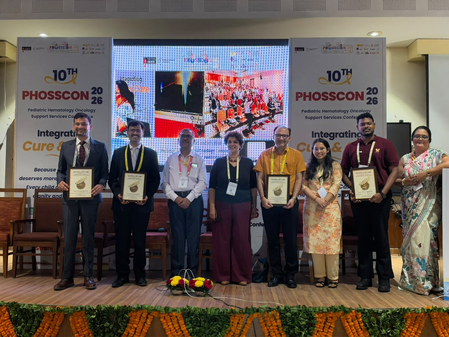
Mohali, Oct 24 (IANS) The quality and quantity of information related to childhood cancer survival rate in the country is likely to get better over the next five years due to the big strides taken during the past decade, said Sameer Bakhshi, Professor and Head of Department of Medical Oncology at AIIMS, New Delhi, on Saturday.
Addressing the10th Pediatric Haematology Oncology Support Services Conference (PHOSSCON 2026) here, Bakhshi said, “Of the information we have today, three-fourths has come in the last 10 years. On a graph, if the information for the last three decades is treated as almost a flat line, it could shoot up sharply in the next five years.”
Bakhshi shared his experience on challenges related to inadequate data on survival rates in light of his AIIMS team’s landmark research that consolidated three decades of Indian childhood cancer survival evidence across 182 studies involving 22,886 children, said a statement.
Poonam Bagai, organising chair of all10th PHOSSCON editions and who is a co-author of the AIIMS New Delhi-led study, emphasised the importance of the findings in establishing the evidence needed to track progress towards UNGA 80 resolution for 60 per cent-plus survival for children with cancer by 2030.
She said the study shares insights that promise to help policymakers identify gaps and strengthen accountability in India’s fight against childhood cancer.
Aligning with the Punjab government’s objectives, the two-day conference, which began on Saturday at the Indian Institute of Science Education and Research (IISER) Mohali, SAS Nagar, is offering a platform for discussions on childhood cancer survival and the evidence needed to improve outcomes.
Punjab offered an important example during the discussion. Building on CanKids’ partnership with the state government since 2017, an Integrated Childhood Cancer Care Framework is being developed with HBCH Mullanpur, AIIMS Bathinda and CMC Ludhiana as key hubs.
The session on “Towards 60 per cent-plus survival: From Evidence to Action” was led by Bagai, Member, ICMR Central Ethics Committee on Human Research, Cankids founder and Childhood Cancer International’s WHO South East Asia Region Representative.
Bagai led the discussions on the ambition of reaching a childhood cancer survival rate of 60 per cent or more by 2030, highlighting the importance of research, reliable data and collaboration.
Reflecting on the journey begun in 2015, Bagai said: “Over 10 PHOSSCONs, research, advocacy and healthcare systems have changed. Today, we are asking a bigger question — not just how to help children through treatment, but how to help more children survive.”
Other sessions at the conference focused on access to treatment and financial protection for families; stronger collaboration between society and the medical community; support systems from diagnosis and treatment to survivorship and long-term care and research; and shared learning and future roadmaps for pediatric haematology-oncology support services, the statement said.
–IANS
rch/dan