
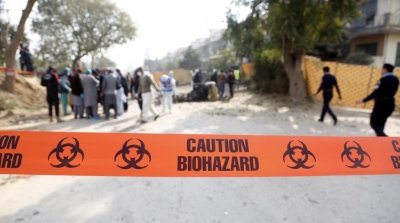
Islamabad, Feb 10 (IANS) The recent suicide bombing at a Shiite mosque in Islamabad which claimed lives of 36 people and injured several others showcased the persistent targetting of Shiite community of Pakistan by extremist groups and the continued fragility of their security, a report has stated.
The blast took place at Khadija al-Kubra Mosque in Tarlai area of Islamabad on February 6 during the Friday prayers. An affiliate of ISIS terrorist group has claimed responsibility for the attack. Pakistan’s Interior Ministry has said that four suspects linked to the bombing in Islamabad have been arrested.
“This attack underscores the persistent targetting of Pakistan’s Shiite community by extremist groups and the continued fragility of their security. The pattern reveals a deliberate strategy by militants to focus on Shiites, aiming to fuel sectarian strife and broader instability across the nation. This attack is but one recent example in a decades-long campaign of lethal violence against Pakistani Shiites. Authorities have recorded scores of similar assaults over the years, claiming the lives of thousands,” a report in ‘Islam Times’ stated.
It recalled that at least 150 people were killed and 100 others were injured in a terrorist attack that targeted Shiites of Pakistan-occupied Gilgit Baltistan (PoGB) in 1988. Violence against Shiite Muslims continued throughout the 1990s and it increased further with the emergence of terrorist group Lashkar-e-Jhangvi (LeJ) in 1996.
The group even announced that their aim was the “cleansing” of Shiites from Pakistan, leading to several targeted killings and brutal attacks. A series of massacres and killings were reported in Karachi and other regions from 1998-1999, with Shiite professionals, intellectuals, and ordinary citizens being specific targets.
“With the dawn of the third millennium, sectarian assassinations and bombings targeting Pakistan’s Shiite population rose sharply. Between 2001 and 2004, hundreds of Shiite worshippers, gatherings, and religious sites came under attack by extremist groups such as Sipah-e-Sahaba and Lashkar-e-Jhangvi,” the ‘Islam Times’ report stated.
“One of the deadliest attacks of this period occurred on July 4, 2003, when a Shiite Hazara mosque in Quetta, the capital of Balochistan province, was targeted. A suicide bombing followed by gunfire killed more than 53 people and wounded dozens. Lashkar-e-Jhangvi, a group known for its explicit campaign against the Hazara Shiite community, carried out the attack,” it added.
Several bombings and assaults targetting Shiite gatherings were reported in Islamabad, Karachi, and Lahore in 2006 and 2007. Violence further increased during the 2010s, with extremist groups including Tehrik-e-Taliban Pakistan, Lashkar-e-Jhangvi, Sipah-e-Sahaba, Jundallah, and ISIS-related factions playing a significant part in this wave of sectarian violence.
On April 16, 2010, Lashkar-e-Jhangvi launched a bombing attack at a hospital in Quetta, followed by a shooting attack, claiming lives of 12 Hazara Shiites and injuring 47 others. As many as eight people were killed and 15 others were injured after terrorists opened fire on a Shiite gathering in Quetta in May 2011.
Armed militants attacked a bus carrying Hazara Shiites in Quetta in September 2011, claiming lives of at least 26 passengers and injuring six others. Reports documented a rise in targeted killings of Shiite activists, intellectuals, and civilians in 2012. As per the available statistics, over 450 Shiites were killed in Pakistan in 2012, the report recalled.
One of the most brutal attacks occurred on February 28, 2012 in Khyber Pakhtunkhwa as militants from the group Jundallah stopped several buses, separated Shiite passengers, and executed 18 people on the road. In 2012, Shiite passengers were forcibly removed from buses and killed in a shooting incident in PoGB in 2012.
As many as 130 Shiites and 270 others were killed in a series of coordinated bombings in Quetta in 2013. Jundallah militants opened fire on a bus carrying Ismaili Shiite passengers in Karachi in May, 2015, killing 45 people and injuring dozens others. A bombing attack took place during Ashura procession in Sindh’s Jacobabad, in Sindh province in October, 2015, claiming lives of 23 people and injuring several others.
A bomb exploded in a market in Parachinar in 2017, killing 24 people and injuring 70 others. As many as 16 people were killed in an explosion that took place at Hazara market in Quetta in 2019. In March 2022, ISIS’s Khorasan Province launched a suicide bombing attack at a mosque in Peshawar, killing 63 people and injuring 196 others. A large convoy of vehicles carrying Shiites was ambushed in Khyber Pakhtunkhwa in 2024, killing at least 54 people dead and injuring over 86 others.
“Over the past three decades, terrorist attacks against Pakistan’s Shiite population have risen steadily and alarmingly, evolving into one of the country’s deepest security and social crisis. Organised extremist groups — particularly takfiri networks — have deliberately targeted mosques, religious ceremonies, convoys, and Shiite-populated areas in an effort to spread fear and instability nationwide. An examination of these attacks shows that they have expanded not only in number but also in lethality, geographic reach, and operational sophistication year after year,” the report highlighted.
–IANS
akl/as