
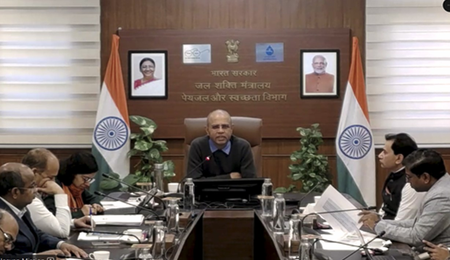
New Delhi, Feb 17 (IANS) Har Ghar Jal under the Jal Jeevan Mission (JJM) has entered a crucial phase of transitioning towards community‑owned and managed rural water service delivery, Ashok K. K. Meena, Secretary, Department of Drinking Water and Sanitation (DDWS), Ministry of Jal Shakti, said on Tuesday.
Addressing the 6th edition of the District Collectors’ ‘Peyjal Samvad’, Meena said community ownership and management of water service is central to strengthening long‑term functionality and quality.
The event brought together senior officials, district administrations, and sector experts to deliberate on strengthening the implementation of Har Ghar Jal under the Jal Jeevan Mission (JJM).
Underscoring the pivotal role of District Collectors, Meena stressed the importance of systematic handover of schemes to Gram Panchayats, in line with constitutional provisions, and the need to ensure that communities assume full ownership of operations and maintenance.
Referring to encouraging examples from various States, including 24×7 systems successfully managed by Gram Panchayats and strong leadership demonstrated by women Sarpanches, he said that these models reflect the growing strength of local governance in the water sector.
He said the forthcoming extension of Jal Jeevan Mission will prioritise saturation of single‑village schemes, expansion of solar‑based infrastructure, comprehensive asset mapping through PM Gati Shakti, creation of a unified scheme database, and financial reconciliation to enhance transparency.
Meena urged all districts to accelerate scheme handovers, strengthen community‑led processes under Rajya Jal Utsav and Lok Jal Utsav, and intensify efforts to ensure sustainable service delivery, reaffirming the commitment to achieving the vision of safe, adequate drinking water for every rural household.
Deputy Secretary, National Jal Jeevan Mission, Ankita Chakraborty, congratulated the districts whose initiatives were selected for presentation, noting that their efforts are contributing to a growing national repository of best practices in rural water service delivery.
She highlighted that the Samvad serves as a platform for peer learning and exchange of innovative ideas, underscoring that districts are the fulcrum where policies translate into outcomes and community-led approaches shape sustainable systems.
Referring to the days’ focus on Jal Utsav-Jal Mahotsav, she emphasised the shift towards community-owned and managed rural water services, and the pivotal role of district leadership in ensuring service quality, convergence, and citizen engagement.
–IANS
rch/dan