
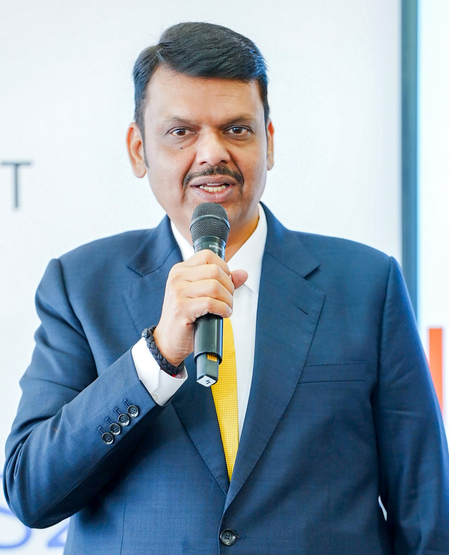
Mumbai, Feb 17 (IANS) Chief Minister Devendra Fadnavis on Tuesday said that large-scale action is needed to address the growing challenges of climate change and Mumbai Climate Week will be an important milestone in this regard.
He stated that Maharashtra is ready to lead the action program on climate change. He also clarified that climate action is not just an environmental responsibility but also the key to future economic competitiveness. He was speaking at the inaugural function of the Mumbai Climate Week summit.
“The coastal metropolis of Mumbai is being hit by climate change. Heavy rains are frequently seen disrupting transport systems, flooding houses, shutting down businesses and affecting livelihoods. Heat waves are affecting construction workers, hawkers and farmers. In rural areas, unseasonal rains destroy harvested crops, which has a huge economic and social impact. Therefore, climate change has become a serious issue before the administration today,” said the chief minister.
He said that under the leadership of Prime Minister Narendra Modi, India has taken the path of balancing economic growth and environmental responsibility. The country has made rapid progress in the field of renewable energy and India is leading the world in the expansion of clean energy.
“Maharashtra is also playing an important role in this transformation. Currently, a large amount of energy capacity has been built in the state and the goal is to increase the share of green energy to more than 50 per cent by 2030. For this, emphasis is being placed on clean hydrogen, electric transport, biofuels and sustainable infrastructure,” he added.
CM Fadnavis said that Maharashtra does not see climate action as just compliance, but as a huge opportunity for investment, innovation and job creation.
Global capital is shifting towards sustainable markets and low-carbon technologies are making clean solutions more affordable.
States that embrace change quickly will attract capital and talent. Maharashtra will lead this transformation, he noted.
“The state is focussing on increasing the use of renewable energy in the industrial sector, promoting electric mobility in cities, and making public transport and logistics systems more eco-friendly. Work is underway to develop flood control systems, climate smart urban planning, and data-based forecasting system. Sustainability and disaster resilience are being incorporated from the outset in major infrastructure projects in the Mumbai Metropolitan Area,” said the chief minister.
Stating that climate action is equally important in rural areas, he said that in view of changing rainfall patterns, water stress and coastal hazards, emphasis is being placed on developing climate resilient agriculture, efficient water management and technology-based rural value chains.
This change will create economic opportunities for the next generations. Stating that the huge investment required for climate change cannot be achieved through public funds alone, he called for cooperation from international financial institutions and the private sector.
Highlighting the need for blended finance, risk-sharing and capital for innovation, Mumbai can become an effective hub for global climate finance. “The concept of climate justice is equally important and developing countries should not be forced to choose between development and environment. Both objectives can be achieved through the right partnerships,” he observed.
Union Minister for New and Renewable Energy, Pralhad Joshi, in his speech said that Maharashtra has done very well in new and renewable energy and PM Kusum Yojana.
Taking note of Maharashtra’s performance in PM Kusum Yojana, he announced the sanction of one lakh more pumps for Maharashtra.
“Mumbai Climate Week is a symbol of climate change dialogue being translated into action. India, a fast-growing economy, is taking concrete steps towards reducing emissions and is setting an example of how to combine economic growth with environmental responsibility.
“Maharashtra has made remarkable progress in the renewable energy sector through public participation and has installed solar power panels in lakhs of homes. The state has set ambitious targets for solar power generation and is focussing on finding technology-based solutions for energy stability and sustainability. When climate action becomes a people’s movement, transformation happens faster,” said minister Joshi.
Maharashtra Minister for Environment and Climate Change Pankaja Munde said that the state is adopting the direction of climate sensitive development while being at the forefront of industrialisation, urbanisation and development.
An action-oriented policy is being implemented in all sectors of energy, urban development, water and infrastructure keeping sustainability at the centre. She mentioned that emphasis is being placed on expansion of renewable energy and energy efficiency in public infrastructure, inclusion of climate risks in city planning and department-wise sustainable planning.
Meanwhile, a special postage stamp and a report on climate change were released by the CM and Union Minister. The Mumbai Metropolitan Region Development Authority (MMRDA) and United Nations Environment Programme signed an MoU to prepare climate-resilient plans for Mumbai. Another MoU was signed between MMRDA and C40Cities (a network of mayors from the world’s leading cities) to strengthen urban solutions and climate change strategies.
–IANS
sj/rad