
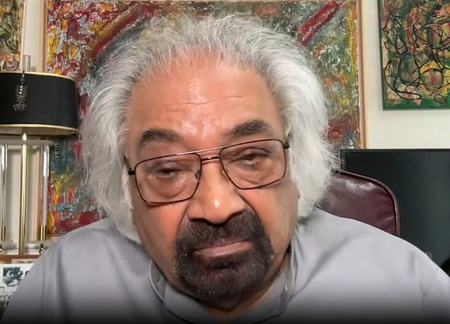
New Delhi, Oct 15 (IANS) Indian Overseas Congress chief Satyanarayan Pitroda, popularly known as Sam Pitroda, on Thursday said the Cockroach Janata Party (CJP) and the student movement were only parts of a larger political and social picture, with several developments unfolding simultaneously across the country. He argued that these issues were part of the wider debate on governance and perceived inequality.
Speaking exclusively to IANS, Pitroda said, “Before we talk about the CJP, we need to understand what is going on in the nation. The CJP and the student movement are just pieces of a bigger puzzle. They are not the only pieces. To me, there are multiple things going on at the same time, bringing a lot of things together.”
He said the first major concern was what he described as an attack on democracy, citing concerns over institutions, civil society, media freedom and the growing concentration of power.
“Different people will look at it differently, but when you begin to capture institutions, undermine civil society, control the media and bring in an authoritarian mindset, where everything is decided by the Prime Minister’s Office, the Prime Minister or what they call the double-engine government, democracy gets attacked in many different ways,” he said.
Pitroda claimed that people were increasingly afraid to express opposing views because they felt they would not be heard or could face action, including investigations by the Enforcement Directorate (ED) or court cases.
He also raised concerns about electoral transparency, saying allegations and doubts surrounding voter registration, eligibility, vote counting, Electronic Voting Machines (EVMs), voter lists and the handling of ballot boxes had contributed to public distrust.
“On one hand, it is about attacking democracy; on the other, many believe that the elections were not fair. You did not count the vote that I cast. Whether it is through my registration, my qualification, my counting, processing, EVMs, voter lists, or boxes being moved, locked up, opened on the street or dumped in a truck, all that has created distrust. I don’t trust this anymore,” he said.
Pitroda acknowledged that people could hold differing views on these allegations, but said the exchanges of blame had become personalised rather than focussed on a fair discussion of issues.
He said the CJP movement emerged when a group of students came together after feeling hurt by being called ‘cockroaches’. According to him, their protest gained momentum amid concerns over examination-related issues, paper leaks, poor infrastructure, the quality of education, rising tuition fees, the growing influence of coaching centres and unemployment.
“These issues affect the next generation and really galvanised young people. The end result was that they were fearless, they had courage and they could really speak up,” he said.
Addressing the controversy over the use of abusive language during protests, Pitroda said some participants had spoken loudly or used inappropriate language, which he viewed as an expression of their anger, although he clarified that he did not approve of such conduct.
He added that people who had previously been afraid to speak were now expressing their views, giving civil society a sense of hope.
Pitroda described the CJP movement as being about fearless opposition, courage and awakening. Referring to an article he had written, he compared the movement to the Arab Spring, calling it the ‘Indian monsoon’ and crediting young people for taking the initiative.
He said another major development was the growing feeling among minorities, Other Backward Classes (OBCs), Dalits and tribal communities that their concerns were being ignored and they were being left behind.
Pitroda cited stagnant wages, rising inflation and declining purchasing power as concerns linked to inequality, injustice and a lack of economic opportunity. He said the student movement had encouraged these communities to believe that they, too, could raise their voices.
The fourth issue, he said, concerned the government’s performance. While acknowledging that the economy was growing at around 7 per cent, he questioned who was benefiting from that growth.
“Who is getting the benefit? A handful of people? In the process, we have not created jobs. Wealth distribution is unequal,” he said.
Pitroda also raised concerns about the delivery of public services, including the provision of mid-day meals and the condition of school buildings, arguing that these issues were part of the wider debate over governance and inequality.
–IANS
jk/rad