
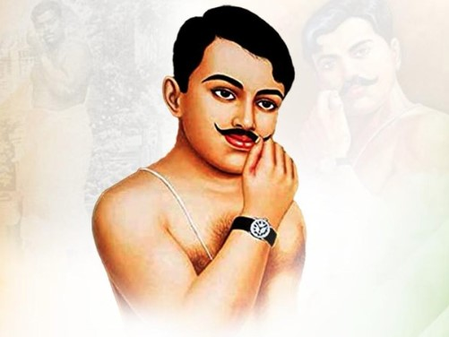
New Delhi, Feb 27 (IANS) Prime Minister Narendra Modi on Friday paid respectful tribute to Chandrashekhar Azad, a fearless freedom fighter, on his martyrdom day and said that he sacrificed everything to free Mother India from the shackles of slavery.
PM Modi took to his social media platform X and said, “My respectful tribute to Chandrashekhar Azad, a brave son of Mother India, on his martyrdom day. He sacrificed everything to free Mother India from the shackles of slavery, for which he will always be remembered.”
PM Modi also made another post and said, “The life of the immortal revolutionary Chandrashekhar Azad shows that the determination to stand firm against injustice is true valour. The story of his sacrifice for the motherland will continue to inspire every generation of the country.”
Chandrashekhar Azad was born on July 23, 1906, in Alirajpur, Madhya Pradesh, as Chandra Shekhar Sitaram Tiwari. At the age of 15, he was arrested during the Non-Cooperation Movement (1920-21). When produced before the court, he defiantly introduced himself as ‘Azad’ (free), stated his father’s name as ‘Swatantrata’ (freedom), and declared his residence as ‘prison’. This fearless response earned him the enduring name by which he became a legend.
Chandrashekhar Azad became deeply saddened when Mahatma Gandhi called off the Non-Cooperation Movement in February 1922. Like several of his contemporaries, this disappointment steered him towards a more militant course of action.
He subsequently joined the Hindustan Republican Army, founded by Ram Prasad Bismil and Sachindranath Sanyal.
Azad played an active role in the Kakori train robbery of 1925, led by Ram Prasad Bismil, which marked a significant episode in the revolutionary struggle.
In 1928, along with his fellow revolutionaries, Azad reorganised the HRA into the Hindustan Socialist Republican Association, with the aim of establishing a socialist republic in India.
Following the death of Lala Lajpat Rai, Azad, along with Bhagat Singh and Rajguru, sought retribution. While Bhagat Singh and Rajguru assassinated British officer John Saunders, Azad shot a police constable who pursued them.
Under Azad’s guidance, Bhagat Singh and Batukeshwar Dutt carried out the bombing of the Central Legislative Assembly on April 8, 1929, aiming to make a political statement rather than cause fatalities.
Azad was also indirectly linked to the attempt to derail the Viceroy’s train in December 1929, further exemplifying his commitment to armed resistance against colonial rule.
In 1928, the Hindustan Republican Association (HRA) was reorganised into the Hindustan Socialist Republican Association (HSRA) at a historic meeting held at Feroz Shah Kotla in Delhi. Prominent members present included Bhagat Singh, Bejoy Kumar Sinha, Shiv Varma, Jaidev Kapur, Bhagwati Charan Vohra, and Sukhdev. Chandrashekhar Azad did not attend this meeting.
The reorganisation marked a significant ideological shift. Bhagat Singh and his associates emphasised socialism as a guiding principle, envisioning India’s independence not merely as political freedom but as economic and social emancipation for the masses. The leadership model adopted was collective in nature, moving away from reliance on individual revolutionary acts towards a broader mass movement.
Chandrashekhar Azad, though absent from the Kotla meeting, was appointed as the Commander of the Military Division of the HSRA. In this role, he was tasked with planning and executing organised armed resistance against colonial authority.
On February 27, 1931, Chandrashekhar Azad was betrayed to the police at Alfred Park in Allahabad (now Prayagraj). Surrounded by police forces, he fought until his last bullet, which he used on himself to avoid capture, staying true to his vow of never being taken alive.
–IANS
jk/dpb