
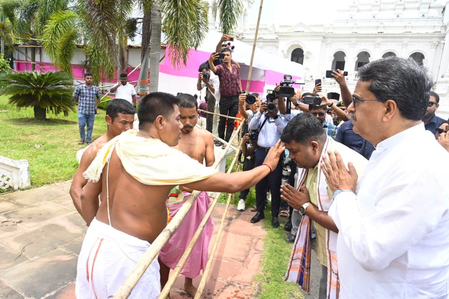
Agartala, Aug 4 (IANS) Tripura Chief Minister Manik Saha on Tuesday said that the state’s centuries-old traditional ‘Ker Puja’ symbolises faith, unity and harmony among tribal and non-tribal communities, while reflecting Tripura’s rich cultural and spiritual heritage.
The Chief Minister, accompanied by BJP state President Abhishek Debroy, West Tripura District Magistrate Vishal Kumar and other dignitaries, observed the Ker Puja from outside the notified ritual area at the historic Ujjayanta Palace in Agartala, in keeping with the age-old customs associated with the festival.
“On this auspicious occasion of Ker Puja, I had the opportunity to receive blessings,” Saha told the media after observing the centuries-old festival, which is also celebrated in tribal-dominated areas across the state.
In accordance with the customary traditions of Ker Puja, outsiders are not permitted to enter the notified ritual area during the observance. The festival is celebrated in Agartala, different parts of Tripura, a few other Northeastern states, as well as in the Chittagong Hill Tracts of neighbouring Bangladesh.
As part of the strict traditional code governing the festival, activities such as birth, death, and even recreation are prohibited within the notified ritual boundaries until the puja concludes.
The annual Ker Puja, organised primarily by the indigenous tribal communities, involves intricate and time-honoured rituals performed for the well-being of the people, protection of the land, and to ward off evil spirits and negative forces.
The two-and-a-half-day-long Ker Puja is observed approximately one week after the conclusion of the seven-day Kharchi Puja, during which the 14 Hindu deities of Tripura are worshipped simultaneously.
This year’s week-long Kharchi Puja was held at Puran Habeli, the former capital of the erstwhile princely state, now known as Khayerpur, around eight km north of Agartala.
The Chief Minister said that one of the principal objectives of Ker Puja is to promote goodwill, social harmony and the spirit of brotherhood among all sections of society. “On the occasion of the traditional Ker Puja, I extend my heartfelt greetings and best wishes to all the people of Tripura. We all know that Ker Puja is observed seven days after the Kharchi Puja held at the Chaturdash Devata Temple in Khayerpur. This traditional festival began during the reign of the erstwhile king Maharaja Trilochan,” Saha said.
He added that the rituals continue to be performed in accordance with long-established customs.
While the puja is now conducted in front of the royal palace, in earlier times the entire palace complex used to fall within the sacred Ker boundary. “The Chantai (priests), who worship the 14 deities at the Chaturdash Devata Temple, have come here to perform the rituals. We have received their blessings. This puja is conducted for the development, peace and overall well-being of the state,” Saha said, adding that a symbolic bamboo structure is worshipped as part of the rituals.
Taking to X, the Chief Minister wrote: “I extend my heartfelt greetings and best wishes to the people of the state on the occasion of Tripura’s traditional Ker Puja. Ker Puja is a unique symbol of our rich heritage, culture and spiritual beliefs. May this sacred festival bring peace, good health and prosperity into everyone’s lives — this is my prayer.”
The Chief Minister further said that another important objective of Ker Puja is to strengthen unity among people and collectively pray for protection from diseases and other calamities. Historians noted that Ker Puja has traditionally been performed to prevent evil forces from causing harm, safeguard society from epidemics and ensure peace and prosperity.
The observance also seeks to nurture a strong sense of brotherhood and communal harmony. Apart from the main observance in front of the Ujjayanta Palace, members of the Tripuri, Reang and several other indigenous tribal communities perform Ker Puja in their respective villages following their traditional customs and rituals.
Following the signing of the merger agreement between Tripura Regent Maharani Kanchan Prabha Devi and the then Governor-General of India on October 15, 1949, Tripura came under the administration of the Government of India.
The merger agreement made it mandatory for the Tripura government to continue patronising 14 temples and several traditional religious observances, including Kharchi Puja, Ker Puja, and the revered Mata Tripura Sundari Temple — one of the country’s 51 Shakti Peethas — which had long been supported by the erstwhile Hindu princely rulers.
In accordance with the provisions of the merger agreement, the Tripura government has continued to bear the expenses of these traditional festivals and temples for several decades, preserving the state’s unique cultural and religious legacy.
–IANS
sc/skp