
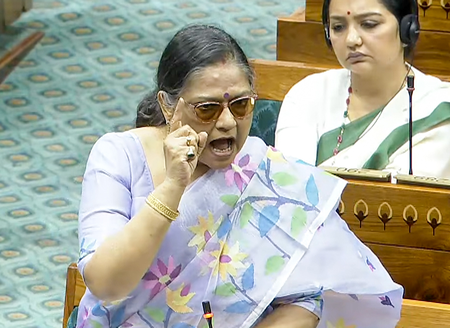
Kolkata, May 25 (IANS) Trinamool Congress (TMC) MP Kakoli Ghosh Dastidar has sharply questioned the role of I-PAC in the party’s recent electoral setbacks and blamed “outsiders” for causing internal harm to the organisation.
In an exclusive interview with IANS, the veteran parliamentarian, who has been associated with the TMC for over 40 years, criticised the party’s growing dependence on external agencies and highlighted how certain individuals who joined after the party came to power have weakened its foundations.
With over four decades of association with the Trinamool Congress, Ghosh Dastidar spoke with striking candour about the party’s journey, from its struggling days in opposition to its ascent to power.
She said that she had stood by the party during its most challenging phase, when workers faced physical assaults and political persecution on the streets.
“I struggled during the party’s difficult times and contributed to strengthening the organisation through sheer hard work. I did not join the party during its good times,” she told IANS.
She added that she stood by the party even when people were being beaten up on the streets and that the organisation became a strong force after a prolonged struggle, eventually attaining power after nearly 20 years.
The veteran MP took veiled swipes at leaders and workers who joined the TMC only after it gained power, suggesting that many did so for personal gain rather than ideological commitment or organisational contribution.
According to her, this influx of late entrants has diluted the party’s original spirit and created internal discord.
Ghosh Dastidar reserved her sharpest criticism for I-PAC, the political consultancy agency entrusted with crafting the TMC’s electoral strategy. She described the agency’s working style as flawed and disconnected from ground realities.
“Our workers are not anyone’s servants. They work out of their love and faith in Mamata Banerjee and the party. However, the people from I-PAC treated them poorly, which led to growing resentment among the workers,” she said.
She alleged that agency representatives often behaved arrogantly, ignoring the advice and experience of local leaders and grassroots workers.
“Some members of the agency had begun to perceive themselves as wielding immense authority,” she remarked.
Ghosh Dastidar pointed out that while I-PAC lacked sufficient experience in the complexities of grassroots politics in Bengal, TMC workers had been battle-hardened through years of electoral contests.
The MP acknowledged that the party’s defeat in the Assembly elections stemmed from multiple factors.
She admitted that in several areas, there was visible public resentment against the government, including complaints of corruption at the Panchayat and Councillor levels.
She also referred to widespread discontent over the Special Summary Revision (SSR) process, during which lakhs of names were allegedly struck off the electoral rolls arbitrarily.
Describing her resignation from the post of AITC District President for the Barasat parliamentary constituency as a “moral responsibility”, Ghosh Dastidar said she stepped down after the party lost five out of seven Assembly seats in the area.
She further stressed that it is the fundamental duty of any government to ensure the safety and security of its citizens.
“If any citizen feels insecure or faces threats, such as the seizure of their land, it is the government’s duty to protect them,” she asserted.
With the crucial 2026 Assembly elections on the horizon, Ghosh Dastidar’s remarks carry significant weight.
She warned that continuing to outsource campaign strategy to external agencies without adequately empowering local leadership could prove costly.
The TMC, she implied, must return to its roots, value its loyal workers, and address genuine public grievances if it wishes to regain lost ground.
–IANS
sktr/dan