
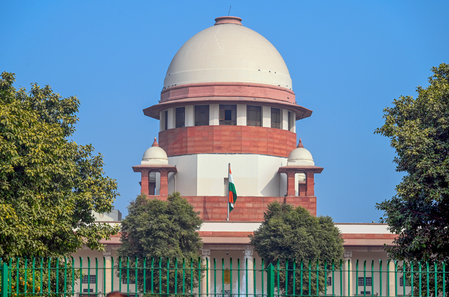
New Delhi, July 7 (IANS) The Supreme Court on Tuesday ruled that banks and the Indian Banks’ Association (IBA) cannot include advocates in the banking sector’s “Caution List” merely on allegations of professional negligence, holding that such action amounts to an impermissible assessment of a lawyer’s professional competence, which falls exclusively within the disciplinary jurisdiction of the Bar Councils under the Advocates Act, 1961.
A bench of Justices PS Narasimha and Alok Aradhe, allowing an appeal filed by advocate Ajay Vijh, set aside the Allahabad High Court’s order dismissing his writ petition and directed the immediate removal of his name from the IBA’s Caution List.
The apex court held that while banks are free to discontinue the services of panel advocates if dissatisfied with their work, they cannot circulate adverse remarks regarding an advocate’s alleged professional negligence through the Caution List mechanism.
“The Caution List may or may not be a public document, but its circulation to all the banking institutions operates as a declaration about (in)competence, as well as the negative character of the advocate, having serious implications on his right to practise his profession,” the Justice Narasimha-led Bench observed.
It clarified that the Reserve Bank of India’s (RBI) circulars on maintaining a Caution List are intended to deal with cases involving fraud and cannot be extended to cases of alleged negligence or erroneous legal opinions rendered by advocates in the course of their professional duties.
“In the present case, where the allegation against the appellant pertains solely to negligence, the inclusion of his name in the Caution List is unsustainable,” the top court said.
It further ruled that allegations of professional misconduct or negligence against advocates can only be examined by the disciplinary authorities constituted under the Advocates Act.
“If the Bank is of the opinion that the appellant is guilty of professional negligence or misconduct in discharge of legal duties as an advocate, the appropriate remedy is to place the relevant material before the competent State Bar Council to take necessary action under the Advocates Act, 1961,” the judgment said.
Holding that banks and the IBA cannot bypass the statutory disciplinary framework, the Supreme Court said: “Permitting banks or banking associations to bypass the disciplinary process under the Advocates Act and unilaterally portray an advocate as professionally incompetent by including his name in a Caution List is illegal, unsustainable and impermissible.”
The dispute arose after Canara Bank removed Ajay Vijh from its panel of advocates and recommended his inclusion in the IBA’s Caution List over an allegedly erroneous legal opinion rendered in 2015 concerning title verification of a mortgaged property.
His name was subsequently included in the list under the category “Third Party Entities Involved in Fraud”, with remarks alleging “wrong legal opinion” and negligence.
The apex court observed that while banks are entitled to terminate empanelment of advocates based on contractual considerations, they cannot publicly declare an advocate professionally negligent through a mechanism intended to alert banks about fraudulent entities.
It also held that the Allahabad High Court erred in dismissing the writ petition on the ground that the IBA is not “State” under Article 12 of the Constitution, observing that the challenge involved infringement of the advocate’s fundamental right to practise his profession under Article 19(1)(g).
Apart from granting relief to the appellant, the apex court issued wider directions to strengthen the legal profession’s regulatory framework.
Observing that independence of the Bar must be accompanied by accountability, it directed the Bar Council of India (BCI) to undertake a comprehensive performance audit of its disciplinary mechanisms and those of the State Bar Councils to assess their efficiency, transparency and effectiveness.
“The purpose of this exercise is not to attribute blame but to identify systemic strengths and weaknesses. The objective should be evidence-based reform aimed at improving the effectiveness of the disciplinary framework while preserving fairness and professional independence,” the bench said.
The Supreme Court also directed the BCI to institutionalise Continuing Legal Education (CLE) for advocates and consider establishing a National Legal Academy (NLA), on the lines of the National Judicial Academy for judges, to provide structured post-enrolment professional training.
Directing the BCI to constitute a team of senior and junior lawyers along with experts to examine the proposal, the apex court said: “There is no dearth of expertise, experience, vision and wisdom amongst members of the Bar. All that is required is to bring them together and enable the idea to take shape.”
The matter has been directed to be listed again on August 31 for considering issues relating to Continuing Legal Education and the proposed National Legal Academy, with the BCI asked to place on record the steps taken in compliance with the top court’s directions.
–IANS
pds/vd