
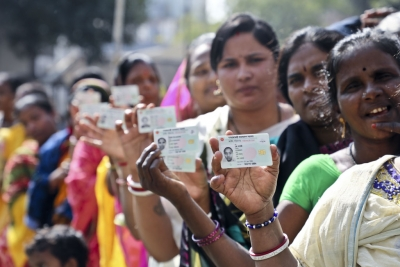
New Delhi, Feb 10 (IANS) Bangladesh is set to hold one of the most consequential, yet contentious elections since its 1971 independence, with the 13th general election to be held on February 12, to select the next government, and a Prime Minister.
This time, voters will also receive two ballots: one to elect Members of Parliament and another for the referendum question on the “July Charter”.
Citizens will vote “yes” or “no” on the implementation of the “July National Charter 2025”, according to Dhaka Tribune.
The Charter is a political and constitutional reform framework designed to institutionalise democratic governance and limit authoritarian power after the 2024 uprising.
Its aims to institutionalise democratic reforms and prevent the concentration of executive power.
It also proposed granting protections to participants in the uprising, called “July Fighters”; reform governance, judiciary, and electoral systems, including restoring a neutral caretaker government for elections; strengthen fundamental rights and ensure inclusivity in national governance.
According to the government, 47 of the 84 proposals require constitutional amendments, while the remaining 37 will be implemented through laws or executive orders, reported Bangladesh’s Business Standard.
“If ‘Yes’ wins, the Constitution Reform Council of the next Parliament must complete the required constitutional amendments within 270 days, or nine months,” it added.
In case the Council fails to do so in this period, a Constitution Amendment Bill from the interim government will automatically be considered passed.
The Charter is a draft of reforms packaged in the aftermath of political uprising that ousted the Shiekh Hasina-led Awami League government in August 2024, which was acknowledged by most political parties last year.
Among changes proposed include a term limit for Prime Ministers, introducing bicameral Legislature, providing stronger judicial independence, increasing powers for bodies involved in election oversight, among others.
If approved, the next Parliament will also serve as a Constitutional Reform Council tasked with enacting the approved constitutional amendments within 270 days, reported the Bengali daily Prothom Alo.
Approval ensures automatic enactment if the Council fails to complete reforms in time, it said.
Incidentally, this will be the third time in Bangladesh that a charter of reforms has been presented, reports added.
Earlier, the first one was presented after President Hussain Muhammad Ershad’s exit from power seized power through a bloodless coup by overthrowing President Abdus Sattar of the Bangladesh Nationalist Party (BNP) in 1990, the second in 2007 during the caretaker rule after the end of Khaleda Zia’s term as the Prime Minister.
According to a Daily Star report, there are 84 reform proposals now, half requiring constitutional amendments.
It said that the “Charter has ignited a national debate about the very mechanisms of popular sovereignty. Central to this discourse is the vital question: should Bangladesh hold a referendum to ratify these monumental changes?”
“The argument that a referendum is both legally feasible and constitutionally desirable offers a rare, momentous opportunity to re-anchor the state’s legitimacy in the direct will of the people, invoking the foundational principles of constitutionalism and democratic theory,” it opined.
Given the fractured political climate, it said that a referendum may be both legally feasible and constitutionally desirable, offering a direct channel for the people to sanction reforms and thereby immunise them against partisan contestation.
“A principal critique is that the Constitution of Bangladesh does not explicitly provide for referenda. Yet, critically, it does not prohibit them either. This silence is a space for constitutional imagination,” the report opined.
With Parliament dissolved and the interim authority constrained by Supreme Court rulings against the doctrine of necessity, traditional legal pathways for reform are unavailable.
A referendum thus emerges as the only legitimate mechanism to anchor the new constitutional order in the sovereign will of the people, it said.
–IANS
jb/khz