
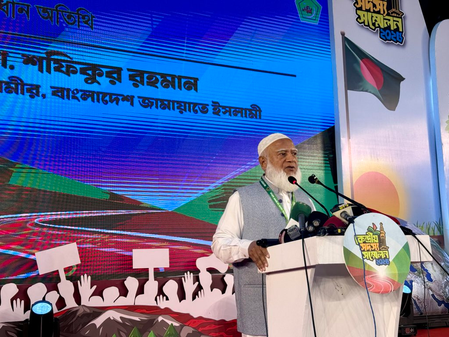
Male, Feb 11 (IANS) Bangladesh’s radical Islamist party Jamaat-e-Islami’s recent statements and manifesto expose a striking contradiction, projecting an image of inclusivity and protection for women, while its longstanding regressive attitudes towards them remain unchanged. The promises of representation and safety by Jamaat are weakened by the exclusion of women from leadership roles, the absence of female candidates, and the continued rhetoric that confines women to the domestic sphere, a report said on Wednesday.
According to a report in Maldives Insight, Jamaat’s ambiguous stance on Shariah laws further suggests that its vision for women remains regressive, grounded in segregation and subordination rather than empowerment.
For women in Bangladesh, it said, Jamaat’s narrative offers not liberation but a continuation of restrictions, framed in the language of dignity and protection.
“The question of women’s empowerment within Islamist movements has always been fraught with contradictions, and Bangladesh’s Jamaat-e-Islami offers a striking case study. On the surface, the party’s recent election manifesto appears to embrace inclusivity, pledging representation for women, ethnic minorities, and religious minorities in government. Yet, when examined against the party’s longstanding rhetoric and practices, these promises reveal themselves as cosmetic gestures rather than genuine commitments to gender equality,” the report detailed.
“In campaign speeches, Jamaat Ameer Shafiqur Rahman has repeatedly emphasised women’s ‘security and dignity’ as a top priority. He has assured that women will be safe ‘in homes, on the roads, in workplaces, and everywhere’. The manifesto echoes this sentiment, promising safe working environments, reduced working hours during maternity, and measures such as dedicated bus services, CCTV cameras, and emergency helplines,” it added.
The report highlighted that the pledges made by Jamaat, however, emphasised protection over empowerment, reinforcing the notion that women are vulnerable beings who must be safeguarded rather than active participants in public life.
“Despite these promises, Jamaat-e-Islami has not fielded a single female candidate in the upcoming elections. This glaring omission undermines the manifesto’s claim of ensuring women’s representation in the cabinet. The party’s leadership has also made clear that women cannot hold the highest positions of authority,” it mentioned.
Jamaat’s stance towards women, the report said, lacked meaningful evolution from its founding ideology.
“The party continues to enjoin women to fulfill domestic obligations, while its promises of inclusion remain symbolic at best. The absence of female candidates, the ban on women in top leadership, and the persistence of rhetoric equating women’s public participation with immorality all point to a deep-seated resistance to genuine empowerment,” it noted.
“The manifesto’s pledges of safety and dignity, while superficially appealing, mask a vision of society where women are segregated, subordinated, and denied equal leadership. The party’s ambiguity on Shariah further underscores its reluctance to openly admit its regressive agenda, preferring instead to cloak it in the language of protection and morality,” it stressed.
–IANS
scor/as