
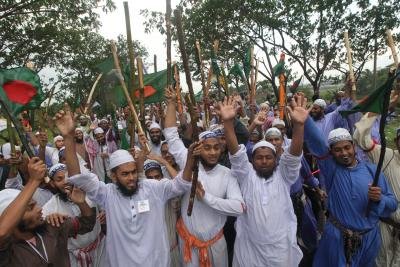
Tel Aviv, Jan 23 (IANS) Bangladesh’s national election on February 12 has raised concerns over the potential resurgence, whether “direct or indirect”, of Islamist radical forces, including Jamaat-e-Islami and affiliated networks. Although these groups often present their activities as part of democratic processes, their ideological roots and historical conduct suggest otherwise, a report highlighted on Friday.
Writing for ‘Times of Israel’, Sergio Restelli, an Italian political advisor, author and geopolitical expert, stated that Jamaat-e-Islami opposed Bangladesh’s independence in 1971 from Pakistan and has long maintained ideological ties with transnational Islamist movements, including the Muslim Brotherhood, which is known for opposing pluralism, secular governance, and regional cooperation.
“Bangladesh’s parliamentary elections scheduled for February 12 may appear, at first glance, to be a distant South Asian political event with limited relevance for Israel or the Middle East. That would be a mistake. In an era when ideology, security, and trade routes are increasingly interconnected, the political trajectory of Bangladesh carries implications that extend well beyond Dhaka and into West Asia, including Israel’s strategic environment,” Restelli stated.
“Bangladesh is one of the world’s largest Muslim-majority countries, with a population exceeding 170 million. It occupies a pivotal geographic position at the junction of South Asia and Southeast Asia, overlooking the Bay of Bengal and sitting astride emerging maritime and land-based trade corridors. Political stability in Bangladesh has long been a quiet but important factor in regional equilibrium. Political radicalisation there would not remain contained,” the expert added.
According to the report, for Israel, the concern lies less with Bangladesh’s internal politics and more with the broader pattern associated with Islamist radicalisation.
“Political Islam, once legitimised through electoral gains, rarely confines itself to domestic agendas. It seeks ideological allies, moral validation, and operational linkages across regions. South Asia has historically been fertile ground for Islamist movements that later developed connections with networks in West Asia, including actors hostile to Israel,” it noted.
The report warned that a shift in Bangladesh towards Islamist radicalism would place another major population centre within the widening sphere of political Islam, extending from parts of South Asia into the Middle East.
“At a time when Israel is already contending with ideological and military threats from Iranian-backed groups, Hamas, and other Islamist actors, the last thing the region needs is the emergence of new ideological hubs that normalise radical narratives under the cover of democratic legitimacy,” it mentioned.
–IANS
scor/as