
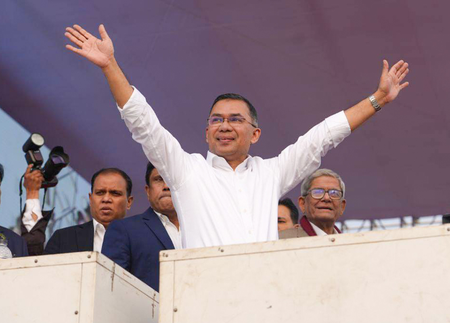
Dhaka/New Delhi, Feb 15 (IANS) Bangladesh’s 13th Parliamentary Election represents a return to “genuine multiparty politics” after years of disputed or largely one-sided contests, accompanied by a referendum that endorsed sweeping constitutional reforms, but the victorious Bangladesh Nationalist Party (BNP) must now address deep-seated concerns in a nation scarred by political violence, as per a report.
Securing more than two-thirds of the seats, the BNP is expected to tackle issues ranging from corruption allegations and minority reassurance to concerns among Awami League supporters and rising youth unemployment.
Economic stabilisation, revival of exports and the management of contentious trade agreements will require immediate focus, according to a report titled “Bangladesh’s Political Reset and the Road Ahead” published by the International Centre for Peace Studies.
“Externally, BNP’s ‘Sobar Agey Bangladesh’ doctrine will be tested amid strained India ties, stalled development projects and impending water-sharing negotiations. How the party navigates these pressures will shape Bangladesh’s political trajectory,” Smruti S. Pattanaik, Research Fellow at the Manohar Parrikar Institute for Defence Studies and Analyses, wrote in the report.
The 13th Parliamentary Election marks a restoration of multiparty competition that has historically characterised Bangladesh’s political transitions, except for the controversial 1996 election to the Fifth National Assembly and the 2014 and 2024 polls conducted under the Awami League.
Although the 2018 election was formally multiparty, it was widely viewed as rigged in favour of the Awami League. The latest electoral exercise, therefore, is seen as a significant step towards rebuilding public trust in the democratic process.
This political transition has also been accompanied by a referendum on constitutional reforms, popularly referred to in Bangladesh as the July Charter. The reform proposals were grouped into four broad categories and put to a public vote, where citizens were asked to choose ‘Yes’ or ‘No’.
According to final figures cited in the report, of the 70,640,056 votes cast, 48,074,429 (68.1 per cent) were in favour, while 22,565,627 (31.9 per cent) opposed the proposals.
The BNP-led coalition’s sweeping victory, securing 212 seats out of 297 declared so far, provides it a decisive advantage in shaping the proposed reforms, particularly those where the party had earlier expressed reservations. A key area of focus will be issues where the BNP differed with Jamaat, which is set to lead the opposition alliance with 77 seats.
At the same time, the report notes that the weight of public expectation now rests heavily on the BNP as a two-thirds majority party. How it manages political, economic and social expectations will determine not only the country’s direction but also the future of the BNP under the leadership of Tarique Rahman.
On the domestic front, the BNP will need to counter perceptions that some within its ranks were involved in corruption, extortion, and the occupation of small businesses. Although the party has expelled around 7,000 members over serious corruption charges, it must avoid repeating the alleged excesses of the outgoing Awami League government, which faced accusations of corruption, authoritarian conduct, and curbing media freedoms, the International Centre for Peace Studies report stated.
The party must also remain mindful of the interests of Awami League supporters and minority communities who participated in the election.
Additionally, it will have to address the aspirations of a politically engaged youth population. With unemployment emerging as a pressing concern, the report suggests that beyond financial assistance, the government must create meaningful employment opportunities for young people.
The economy will demand sustained attention. While the interim administration may have stabilised certain indicators, a stronger push is required. Exports, the backbone of Bangladesh’s economy, have declined, underscoring the urgency of corrective measures.
The recent trade agreement with the United States has also generated debate. The arrangement requires Bangladesh to import cotton yarn from the US for garments exported back to the American market, raising concerns, along with other provisions concluded under the interim regime.
A proposed agreement with UAE-based port operator DP World to manage the New Mooring Container Terminal at Chittagong Port, which had sparked a workers’ strike, has been shelved for now but is expected to resurface in policy discussions.
The report further suggests that the BNP’s foreign policy outlook is expected to be guided by its “Bangladesh First of All (Sobar Agey Bangladesh)” slogan. Its manifesto states that beyond its borders, Bangladesh has “friends not masters”, emphasising sovereignty, national interest, security and the will of the people. While the party has stressed ‘Equality’, ‘Mutual Respect’, ‘Trust’, and understanding in relations with neighbours, particularly India, other political actors have also highlighted dignity as a cornerstone of foreign engagement.
It, however, observes that it remains unclear how the BNP will manoeuvre through a complex regional and global environment where bargaining and compromise often define statecraft. The party has raised issues such as border killings and cross-border push-ins, and its leaders have spoken of taking legal action against foreign nationals residing illegally in Bangladesh.
“It is important for Bangladesh and India to look at the issue of illegal migration and trafficking that takes place across the porous border. Most significantly, the Ganges Water Sharing Treaty, signed in 1996 for thirty years, is going to expire this year. Water sharing issues will dominate India-Bangladesh relations, and there would be pressure on BNP to sign the Teesta,” Pattanaik wrote.
India has extended substantial support to Bangladesh through development initiatives, including an $8 billion line of credit and an additional $500 million credit line for defence cooperation.
Following the fall of Sheikh Hasina’s government, several Indian technical experts, including project engineers, left Bangladesh amid security concerns and anti-India sentiment.
Shortly before the elections, nine senior officials from India’s National Thermal Power Corporation deputed to the Rampal joint India-Bangladesh Maitree Power Station reportedly departed over fears of unrest. The resumption of these projects will be significant.
Meanwhile, the proposed Indian economic zone projects at Mirsarai and Mongla were cancelled in January by the interim administration after remaining stalled for nearly a decade despite land allocation, the report said.
Overall, Pattanaik concluded by noting that India-Bangladesh ties require careful recalibration. While both the BNP and the new opposition have underlined the importance of relations with India, rebuilding trust and forging a durable partnership will depend on how both sides address existing deficits and emerging challenges.
–IANS
sd/vd