
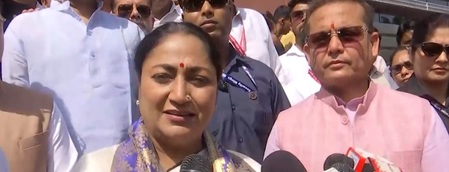
New Delhi, April 14 (IANS) On the 135th birth anniversary of Dr B.R. Ambedkar, Delhi Chief Minister Rekha Gupta on Tuesday visited the Ambedkar Memorial and paid floral tributes, describing Baba Saheb as the pillar on which the strong structure of Indian democracy stands today.
Speaking to reporters, CM Gupta said, “Baba Saheb was the pillar of India on which the strong structure of Indian democracy stands today. He laid the foundation of our democracy, and his contributions will be remembered by every citizen of the country for generations to come.”
She further added, “Today, I visited the Ambedkar Memorial in Delhi and paid my respects. I consider myself fortunate that the Delhi government is working on the path shown by him. His message of equality continues to guide us, and we are committed to ensuring that the benefits of governance reach the last person in the national Capital.”
Highlighting the government’s approach, she said policies are being framed to improve people’s lives and ensure dignity for all.
“We strive to create policies that benefit citizens and enable them to live a life of dignity. Today, I pay my salutations to this great soul, whose legacy will be remembered across the world,” she said.
Every year on April 14, India marks an important day that remembers a leader who played a key role in shaping the nation and its values. Ambedkar Jayanti is celebrated to honour Dr Bhimrao Ramji Ambedkar, one of the foremost architects of modern India. Born in 1891 in Mhow, he was a jurist, economist and social reformer, and also the principal architect of the Indian Constitution.
The day is not just a remembrance of his life but also a tribute to his continuous fight for social justice, equality and human rights. Dr. Ambedkar was born on April 14, 1891, and this day has now become a symbol of social empowerment and the fight against caste discrimination. Over time, Ambedkar Jayanti has established itself as an occasion that reiterates the constitutional principles he promoted: Liberty, equality, and fraternity.
Despite facing discrimination in his early life, Dr. Ambedkar became the first Dalit to receive a doctorate in economics abroad. He studied at Columbia University and the London School of Economics and considered education the most important means of empowerment. As India’s first Law Minister, he led the process of drafting the Constitution, which included special provisions for the underprivileged, including protection of civil rights.
The day holds deep emotional and political significance, especially for the Dalit community, as it commemorates the ongoing struggle against caste inequality and inspires social and economic reforms.
Ambedkar Jayanti, also known as Bhim Jayanti, is celebrated in India as well as in countries such as the United Kingdom, the United States, and Canada, where the Indian community celebrates the occasion with special fervour.
–IANS
jk/rad