
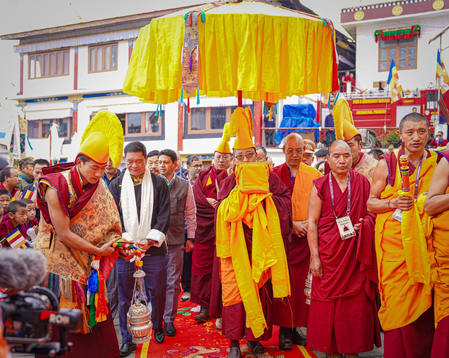
Itanagar, Oct 31 (IANS) Arunachal Pradesh Chief Minister Pema Khandu on Saturday attended the inaugural ceremony of the sacred exposition of the holy relics of Lord Buddha at Gaden Namgyal Lhatse Monastery, popularly known as Tawang Monastery, marking the return of the relics to the state after a gap of 13 years.
The exposition, scheduled from October 31 to November 21, will travel across three districts of the state, providing devotees an opportunity to pay their respects and seek blessings.
The relics will be displayed in Tawang district from October 31 to November 7, West Kameng from November 8 to 14, and Namsai from November 14 to 21.
Expressing gratitude to Prime Minister Narendra Modi for approving the exposition, CM Khandu also thanked Union Minister for Culture Gajendra Singh Shekhawat, the Ministry of Culture and the National Museum for their cooperation in organising the event.
He said the initiative, along with the recently concluded International Tourism Mart in the state, reflected the Centre’s commitment to promoting Arunachal Pradesh’s rich cultural heritage and tourism potential.
Highlighting the spiritual significance of the occasion, the Chief Minister said the teachings of Lord Buddha were particularly relevant in today’s world, marked by tensions, uncertainty and conflict.
He urged people to embrace the Buddha’s message of wisdom, compassion and coexistence in addressing the challenges facing individuals and society.
He also called upon Buddhist followers to practise these teachings in their everyday lives and work towards strengthening peace and harmony among communities.
Khandu conveyed his gratitude to the 14th Dalai Lama for his greetings and blessings on the occasion.
The message was shared with the gathering by Secretary General of the International Buddhist Confederation (IBC), Venerable Shartse Khensur Jangchup Choeden Rinpoche.
The Chief Minister also read out a special message from Prime Minister Narendra Modi, who described the exposition as an occasion of immense spiritual and cultural significance and extended his greetings and best wishes to the people of Arunachal Pradesh.
In his message, the Prime Minister said that the teachings of Lord Buddha had guided humanity towards peace and compassion for more than two millennia and continued to strengthen India’s cultural and spiritual ties with countries across the world.
He highlighted several initiatives undertaken by the Union government to preserve and promote the country’s Buddhist heritage, including the development of important pilgrimage sites such as Bodh Gaya, Sarnath and Kushinagar, the organisation of international Buddhist summits and conferences, and the exposition of sacred relics.
PM Modi also referred to the return of the Piprahwa relics to India after more than a century and the recognition of Pali as a classical language as significant milestones in preserving Buddhism’s intellectual and spiritual legacy.
Describing Arunachal Pradesh as an important part of India’s Buddhist heritage, the Prime Minister highlighted the enduring significance of Tawang Monastery as a major centre of Buddhist faith and learning.
He said the exposition at Tawang, Bomdila and Namsai would enable devotees across the state to connect more closely with their spiritual heritage and the teachings of Lord Buddha.
PM Modi expressed confidence that the exposition, along with the international conference on Buddhism being organised as part of the programme, would deepen appreciation of India’s shared Buddhist heritage.
In a significant announcement, Khandu declared the establishment of the Arunachal Buddhist Confederation to bring together and strengthen the diverse Buddhist traditions and institutions of the state.
The Chief Minister said that Arunachal Pradesh had a distinctive Buddhist landscape, with both Mahayana and Theravada traditions flourishing in different regions.
Mahayana Buddhist communities are concentrated in Tawang, West Kameng, Mechuka, Tuting, the Taksing area and Anjaw, while Theravada Buddhist communities are predominantly found in Namsai and Changlang districts.
Khandu said the decision to establish the Confederation was taken after consultations with senior leaders and representatives of both traditions, including Deputy Chief Minister Chowna Mein and Namsai MLA Jignu Namchoom.
Venerable Agadhamma, Chief Monk of Namsai Pariyatti Sasana Buddhist Vihara, has been selected as the first President of the Confederation, while Thupten Kalden, Director of the Department of Karmik and Adhyatmik Affairs (DoKAA), will serve as its Secretary General.
The Confederation will seek affiliation with the International Buddhist Confederation, creating an institutional platform to promote, preserve and strengthen the state’s diverse Buddhist practices, traditions and institutions.
Khandu also welcomed the Prime Minister’s announcement in the Union Budget regarding the development of Buddhist heritage sites in the Northeast.
He said that following discussions with the Union Minister for Tourism, the Ministry was working on a policy framework to take the initiative forward.
Expressing confidence in the proposed policy intervention, the Chief Minister added that it would benefit Buddhist heritage sites across Arunachal Pradesh and facilitate their preservation, development and promotion.
The inaugural ceremony was attended by Union Minister for Culture Gajendra Singh Shekhawat, Lok Sabha MP Tapir Gao, legislators, the Chief Secretary, representatives of the Ministry of Culture, the National Museum and the International Buddhist Confederation, besides monks and other distinguished guests.
–IANS
sc/khz