
Itanagar, Nov 11 (IANS) Arunachal Pradesh Deputy Chief Minister Chowna Mein on Wednesday highlighted the common challenges confronting Northeastern states in urban development, citing difficult mountainous terrain, scattered settlements, high transportation and infrastructure costs, limited municipal revenue, and vulnerability to natural disasters such as landslides, flash floods, earthquakes and soil erosion.
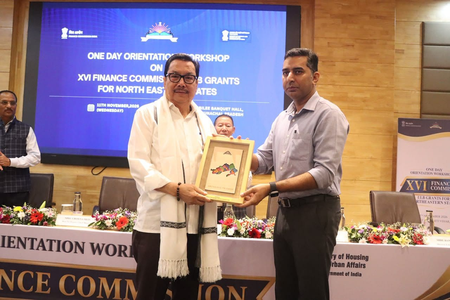
The Deputy CM attended the Regional Workshop on Implementation of the 16th Finance Commission Urban Local Body (ULB) Grants for Northeastern states at the Golden Jubilee Banquet Hall in Itanagar on Wednesday.
The one-day workshop brought together delegates and representatives from six Northeastern states –Arunachal Pradesh, Nagaland, Manipur, Mizoram, Sikkim and Tripura — to discuss the effective implementation of Finance Commission grants and ways to strengthen urban governance and municipal service delivery.
He emphasised that urban development planning in the region must take into account its unique geographical and administrative realities, stating that conventional parameters such as population and area alone may not adequately reflect the actual cost of delivering municipal services in the Northeast.
Referring to the 16th Finance Commission award period from 2026-27 to 2030-31, he noted that the Commission has recommended approximately Rs 7.91 lakh crore in grants for Rural and Urban Local Bodies over five years, including around Rs 3.56 lakh crore for Urban Local Bodies.
The Deputy CM said these grants provide a significant opportunity to strengthen local institutions, improve civic infrastructure and ensure better delivery of essential urban services. He stressed the need to transform municipalities from mere implementing agencies into professionally managed institutions capable of planning, financing, executing and maintaining their own development priorities. He underscored the importance of timely budget preparation, proper accounting, regular audits, transparency and effective financial controls.
Mein also called for strengthening municipal revenue through improved property tax administration, rationalisation of user charges, better collection efficiency and digitisation of municipal revenue systems.
Highlighting key areas requiring priority attention, he emphasised scientific solid waste management, drinking water supply, drainage, sanitation, wastewater management, urban roads, street lighting and climate-resilient public infrastructure.
Mein further noted that building institutional capacity and addressing shortages of qualified technical, engineering, financial and administrative manpower are equally important for effective municipal governance.
Speaking about Arunachal Pradesh, the Deputy CM informed that the state has 47 notified towns, including 27 census towns, spread across approximately 83,743 square kilometres. He observed that the small and dispersed nature of settlements, coupled with difficult terrain, makes the creation and maintenance of urban infrastructure particularly challenging.
The Deputy CM reaffirmed the state government’s commitment to strengthening municipal institutions, improving sanitation and solid waste management, expanding basic urban amenities and promoting planned and sustainable urban settlements.
Outlining the key outcomes expected from the workshop, he called upon participating states to prepare five-year implementation roadmaps with clear priorities and measurable targets, adopt project planning and cost estimation that account for regional realities, and ensure effective convergence of Finance Commission grants with existing Central and state government schemes, including SBM-U and AMRUT, while avoiding duplication of expenditure.
He also urged the Ministry of Housing and Urban Affairs to continue extending technical guidance, capacity-building and handholding support to smaller States and municipalities, particularly during the initial years of implementation.
Mein further observed that the success of the 16th Finance Commission would not be measured merely by the funds allocated or released, but by the quality of infrastructure created, the strength of municipal institutions, the sustainability of civic services and the improvement in the quality of life of citizens.
He expressed appreciation to the Ministry of Housing and Urban Affairs for bringing the North-Eastern States together on a common platform and called for collective efforts towards sustainable, resilient and citizen-centric urban development across the region.
The workshop was attended by Balo Raja, Arunachal Minister for Urban Affairs, Gopal Prasad, Economic Advisor, Union Ministry of Housing and Urban Affairs, along with distinguished guests, delegates from six Northeastern states, resource persons, senior officers, officials from MoHUA and representatives of Janaagraha.
–IANS
sc/uk