
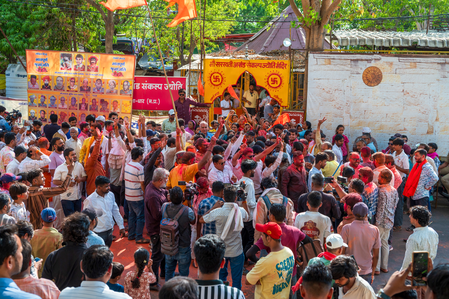
New Delhi, May 16 (IANS) The All India Muslim Personal Law Board (AIMPLB) on Saturday announced its support for a panel that plans to challenge in the Supreme Court the Madhya Pradesh High Court verdict in the Bhojshala Kamal Maula Mosque dispute
The High Court, in its verdict on Friday, declared the mosque complex a Saraswati temple.
Board’s spokesperson S.Q.R. Ilyas said that the Kamal Maula Mosque Committee will challenge the verdict in the Supreme Court, and that the Board will extend every possible support in this legal battle.
Rejecting the High Court verdict, the AIMPLB, in a statement, said that the judgment is contrary to historical facts, official records, archaeological evidence, and even the earlier stand of the Archaeological Survey of India (ASI).
Ilyas stated that the High Court judgment gives primacy to a presumed ancient temple and a civilizational narrative, while ignoring the centuries-old status of the mosque, official documentation, ASI’s shared management arrangement, and the constitutional principle of preserving the religious character of places of worship after Independence.
Ilyas said that the Archaeological Survey of India’s own earlier position had acknowledged the shared religious character of the site.
He said for decades, ASI’s official records and signboards described the site as “Bhojshala Kamal Maula Mosque,” which amounted to official recognition of its disputed and shared religious status.
Ilyas said, under the administrative arrangement of 2003, Hindus were allowed to offer puja on Tuesdays, while Muslims were permitted to offer Friday prayers.
“This arrangement itself was a clear acknowledgement that ASI recognised the historical claims and worship rights of both communities. Therefore, the High Court’s decision to terminate this arrangement marks a departure from ASI’s own earlier stand,” he said.
Ilyas stated that ASI, in its recent survey, has reportedly cited certain pillars, carvings, and architectural elements as evidence of a temple. However, it must also be kept in mind that many medieval Islamic structures incorporated reused material from earlier constructions.
“The mere presence of non-Islamic architectural remains cannot legally extinguish the centuries-old status of a mosque, nor can remnants of an earlier structure serve as conclusive proof of the present religious identity of a site,” he said.
He added that the High Court placed extraordinary reliance on traditions associated with Raja Bhoj, the historical legacy of Sanskrit learning, and ASI survey findings, while overlooking continuous religious usage, official records, and constitutional principles.
Ilyas said that literary and traditional references do not always constitute conclusive historical evidence, and many religious sites in the subcontinent have transformed across different historical periods.
–IANS
rch/dan