
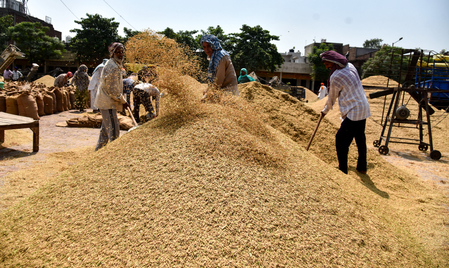
Gandhinagar, Sep 7 (IANS) Gujarat has used artificial intelligence to assess paddy quality at 10 procurement centres across four districts in a pilot aimed at making purchases under the Minimum Support Price (MSP) scheme more transparent and consistent.
The Gujarat State Civil Supplies Corporation deployed AI-based grain analysers during the Kharif Marketing Season (KMS) 2025-26 at centres in Ahmedabad, Mahisagar, Anand and Panchmahal districts.
The pilot recorded 13,334 registrations, with 6,191 paddy samples subsequently assessed using the AI systems.
Of the samples analysed, 3,379, or 54.6 per cent, were classified as Grade-A, while 2,812, or 45.4 per cent, were classified as Common. A total of 341 samples were rejected. Dholka recorded the highest rejection rate at 24 per cent, whereas no samples were rejected at Viramgam.
The 10 centres were Lunawada and Santrampur in Mahisagar; Khambhat and Borsad in Anand; Dholka, Bavla, Viramgam and Sanand in Ahmedabad; and Godhra and Shehera in Panchmahal. Registrations were highest at Khambhat, with 2,663, followed by Lunawada with 2,278.
The AI grain analysers assess samples for foreign matter, damaged or discoloured grains, immature or shrunken grains, admixture and moisture content.
The system requires uninterrupted electricity and one operator at each procurement centre.
The Corporation said its existing third-party grading arrangement requires two people to collect samples and undertake grading using scientific equipment, including in situations where electricity is unavailable.
The state currently procures wheat, paddy, maize, jowar, bajra and ragi under the MSP system through survey and grading agencies.
Wheat and rice are procured according to Food Corporation of India standards, while grains procured under MSP follow Uniform Specifications prescribed by the Central Government.
The Gujarat State Civil Supplies Corporation is the state’s nodal agency for procurement of notified commodities at MSP from farmers when market prices fall below the support level.
The Corporation said its quality-control framework extends beyond procurement. It procures and distributes wheat, rice, paddy, bajra, jowar, ragi, tur dal, gram, groundnut oil, double-fortified salt and M-30 white sugar.
For tur dal, gram, edible oil, sugar and double-fortified salt, it has prescribed quality standards that it says are stricter than Food Safety and Standards Authority of India (FSSAI) requirements.
For tur dal and gram, trucks are sealed with single-use wire seals before being sent to warehouses. Samples collected by warehouse managers are then subjected to 100 per cent cross-verification at the Food Research Laboratory through the Quality Control branch of the Corporation’s head office.
The analysis is carried out using IS:4333 (Part I and II):2018 and IS:2813:2015 methods.
The Corporation said the combination of AI-based assessment, prescribed procurement standards and complete sample cross-verification is intended to ensure that clean and unadulterated foodgrains reach beneficiaries through government schemes, while improving transparency in the public distribution system.
–IANS
mys/uk