
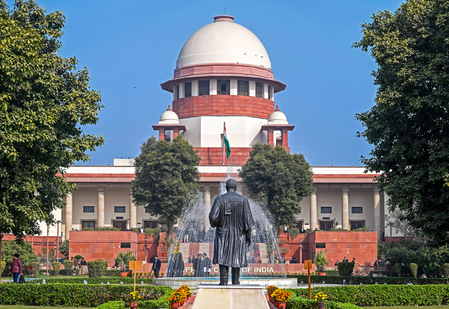
New Delhi, April 6 (IANS) The Supreme Court has held that mere use of abusive language such as the word “bastard” during a heated altercation would not amount to an offence of obscenity under Section 294(b) of the Indian Penal Code (IPC).
A bench of Justices Pamidighantam Sri Narasimha and Manoj Misra made the observation while partly allowing appeals filed by two accused persons challenging their conviction in a 2014 case arising out of a long-standing boundary dispute between close relatives in Tamil Nadu.
In its detailed judgment, the Justice Narasimha-led Bench examined the scope of “obscenity” under Section 294 IPC and clarified that not all vulgar or abusive expressions would attract penal consequences.
“Mere use of the word ‘bastard’, by itself, is not sufficient to arouse the prurient interest of a person. More so, when such words are commonly used in the modern era during heated conversations,” the apex court observed, adding that an act or utterance qualifies as obscene only if it has the tendency to arouse sexual or lustful thoughts, rather than being merely offensive or distasteful.
Setting aside the conviction of the appellants under Section 294(b) IPC, the apex court held that the Madras High Court erred in treating the abusive expression used during the altercation as an obscene act punishable under law.
The case arose from a violent incident in September 2014 involving a boundary dispute between family members, during which one person died after sustaining a head injury.
While upholding the conviction of one of the accused for culpable homicide not amounting to murder under Section 304 Part II IPC, the Supreme Court reduced his sentence from five years to three years’ rigorous imprisonment, taking into account the circumstances of the incident.
The apex court said that the assault occurred in the heat of the moment during a sudden quarrel between relatives and involved a single blow inflicted using a wooden log picked up from the spot.
“The incident… was preceded by an altercation between neighbours, who are close relatives, arising from a boundary dispute, and injury was not caused by using a dangerous weapon, but by a log lying on the spot, and only a solitary blow was inflicted in the heat of the moment,” the bench observed.
In respect of the co-accused, the top court set aside his conviction for culpable homicide, holding that there was no evidence to establish that he shared a common intention to cause such bodily injury as was likely to result in death.
However, the Supreme Court upheld his conviction under Section 324 IPC for causing hurt with a weapon and reduced his sentence to the period already undergone.
Allowing the appeals in part, the bench directed the accused convicted under Section 304 Part II IPC to surrender and serve the remainder of the reduced sentence.
–IANS
pds/vd