

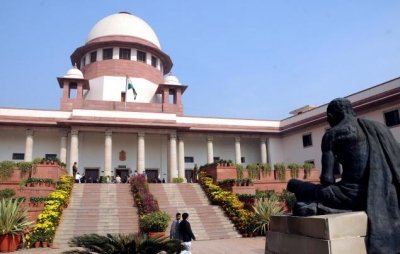
New Delhi, March 30 (IANS) The Supreme Court has expressed strong displeasure over the delay by the Gujarat government in deciding the plea for premature release of a life convict, warning that failure to adhere to the policy timelines could invite “strict penal orders”, including suo motu contempt proceedings.
A bench of Justices Ahsanuddin Amanullah and R. Mahadevan said that despite granting more than three months’ time earlier, the state government had failed to take a final decision on the petitioner’s case, terming the stand taken by the authorities as “absolutely unacceptable”.
“Today also the stand being taken that the Committee is likely to take a decision soon, in our considered opinion, is absolutely unacceptable,” the Justice Amanullah-led Bench observed.
The apex court was hearing a Special Leave Petition (SLP) filed by Mahesh Kumar Dhisalal Jangid, challenging a Gujarat High Court order.
In its previous order passed on December 12, 2025, the top court had recorded the state government’s submission that the petitioner’s case for premature release would be considered as per the Gujarat remission policy. Noting that the petitioner had already completed the minimum required period of incarceration for such consideration, the Justice Amanullah-led Bench had granted time to the state government to take a decision and communicate the same before the next hearing.
Referring to a 1992 circular issued under Section 432 of the Code of Criminal Procedure governing premature release, the Supreme Court highlighted that the policy itself mandates initiation of the process three months prior to completion of 14 years of imprisonment.
“From the aforesaid, it is clear that the policy itself indicates that a person, as and when he or she completes the said period, a final order has to be passed on that day,” the order said.
The bench added that though premature release is not a fundamental right, it assumes the character of a vested right once a policy is framed by the state government.
Expressing concern over non-compliance, the top court said it could have initiated proceedings against all responsible officials but refrained from doing so for the time being.
“Accordingly, we could have initiated proceedings against all the concerned persons, right from the person who initiates the process till the person who actually/finally takes the decision. However, we refrain from doing so, for the present,” the bench said.
It directed that the matter be listed on April 7, at the top of the board and cautioned that any future deviation from the policy would attract stringent consequences.
“It is further clarified that… the same shall entail strict penal orders from this Court, including, but not limited to, initiation of suo motu contempt,” the order warned.
It also directed that its order be transmitted to the Chief Secretary for “strict compliance throughout the state”.
Further, the Justice Amanullah-led Bench made it clear that if a final decision is not placed on record by the next date, senior officials, including the Chief Secretary, Home Secretary and Inspector General of Prisons, would have to remain personally present before the apex court.
“…the Chief Secretary and the Additional Chief Secretary/Secretary, Department of Home… and also the Inspector General of Prisons, Gujarat shall be personally present in Court to show-cause as to why proceedings be not initiated against them,” it added.
–IANS
pds/vd