
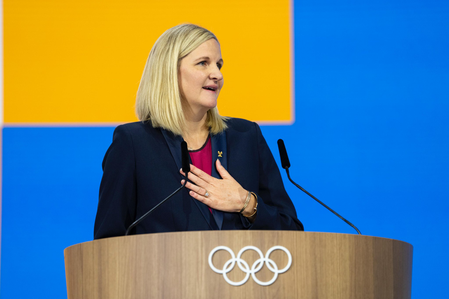
Beijing, Dec 23 (IANS) The year 2025 marked a turning point for the International Olympic Committee (IOC) as Kirsty Coventry, a seven-time Olympic swimming medallist from Zimbabwe, was elected the 10th IOC president. What came over the following months was not a rush of bold declarations, but a measured recalibration of how the IOC listens, decides, and moves forward.
Her historic victory on March 20 in Costa Navarino, Greece, shattered a 131-year precedent, making her both the first woman and the first African to lead the global Olympic Movement, reports Xinhua.
Elected with 49 votes in a first-round ballot, Coventry’s ascent was seen as a symbol of the evolving values she now champions. Outgoing president Thomas Bach hailed the election as a demonstration of unity, noting he was “very much relieved” to see IOC members unite behind Coventry.
Coventry herself reflected on the moment’s weight, stating, “An extraordinary moment. As a 9-year-old girl, I never thought that I would be standing up here one day, getting to give back to this incredible movement of ours.”
“I can’t believe that in 1992 when I had the dream of going to the Olympic Games and winning a gold medal for Zimbabwe, that I’d be standing here with all of you, getting to make those dreams come true for more young people around the world,” she said during her first speech as IOC president, framing her mission around inspiration and accessibility.
While some anticipated a continuation of Bach’s policies, Coventry initiated a “Pause and Reflect” phase upon officially taking office on June 23, hosting a multi-day workshop with IOC members. The message was clear: before setting a new course, Coventry wanted to understand the currents beneath the surface.
“The way you build a successful team is that everyone has to feel they’re individually succeeding. A lot of this process is about listening, then getting collective input from everybody,” Coventry further explained the “Pause and Reflect” decision during an interview with Xinhua in November.
This period of consultation turned into concrete structural reforms by September, under the “Fit For The Future” initiative. Coventry announced the creation of four dedicated working groups, a clear move to address systemic challenges.
These groups focus on the Youth Olympic Games, the Olympic program, commercial partnerships and marketing, and the highly sensitive issue of protection of the female category. On the latter, Coventry has taken a deliberate and science-based stance amidst the global debate.
“We have set a working group to look at the protection of the female category,” she clarified through Xinhua. “It’s a medically driven, scientific discussion. Some people may be jumping the gun. We need to allow the experts to finish their work.”
Another significant early decision was pausing the host election process for future Games, with a working group established to review the timeline and member engagement.
“Members want to be engaged more in the process,” Coventry noted. This initiative opens the door to moving away from the long-term, fixed schedule that has defined recent host elections like LA 2028 and Brisbane 2032.
Her willingness to reassess major commitments was further demonstrated by the IOC’s decision to end its partnership with Saudi Arabia for the inaugural Olympic Esports Games. Coventry framed this not as a retreat, but as responsible governance.
“We jointly agreed that we needed to re-evaluate a number of things,” she explained. “There is a huge opportunity, but there were question marks on how we would implement it and what that would look like. We have to be very clear because that’s new territory for us.”
This move reflected a principle she championed during her campaign: adapting to modern trends without compromising core values. “We must continue to innovate without compromising these principles,” she had stated earlier in March.
Coventry’s ties with China were a focus during her initial months in the role. Her November visit, which included attendance at China’s National Games, served both as a return to the country where she claimed one gold medal, three silvers, and set two world records at the 2008 Olympics, and as an opportunity to engage with an important Olympic partner.
“Anytime I talk about Beijing 2008, I get the biggest smile,” she noted. “It gave me so much.”
During the trip, she met with Chinese TOP sponsors Alibaba, TCL, and Mengniu, reinforcing commercial ties.
“They all spoke about values that align so much with what the Olympic Movement stands for,” she said, pledging to deepen collaboration so “best practices can be shared with the rest of the world.”
The first major test of her administration is imminent with the Milan-Cortina 2026 Winter Olympics, now less than two months away. The Games present logistical challenges due to their geographically spread-out nature, but Coventry has stated its commitment to attending events across the dispersed venues.
“We are going to do our best, and I think right now, where we are in the program in the agenda, yes, that’s the plan,” she told The Associated Press early December.
Beyond logistics, she confronted the persistent challenge of safeguarding the Olympic Movement’s neutrality in a fractured geopolitical landscape, a principle she fiercely defended as a candidate.
Her administration’s stance was put to a definitive test with the question of athletes from Russia and Belarus. In September, the IOC confirmed they would be allowed to compete at Milan-Cortina 2026 as Individual Neutral Athletes (AIN), under the exact same conditions as for Paris 2024.
“This will be nothing new. Nothing has changed,” Coventry said. The move directly reflects her earlier emphasis that “it is essential that the IOC upholds its neutrality and ensures that politics does not interfere with athletes’ opportunities to compete.”
Coventry’s early actions, including structural reforms and reviewed partnerships, appear focused on renewing the institution while emphasising its founding values. As the world turns its eyes to Milan-Cortina, her leadership will move from the planning phase to the global spotlight, ready for its first Olympic-scale examination.
–IANS
bsk/